Foundation Phase: Horst Wein

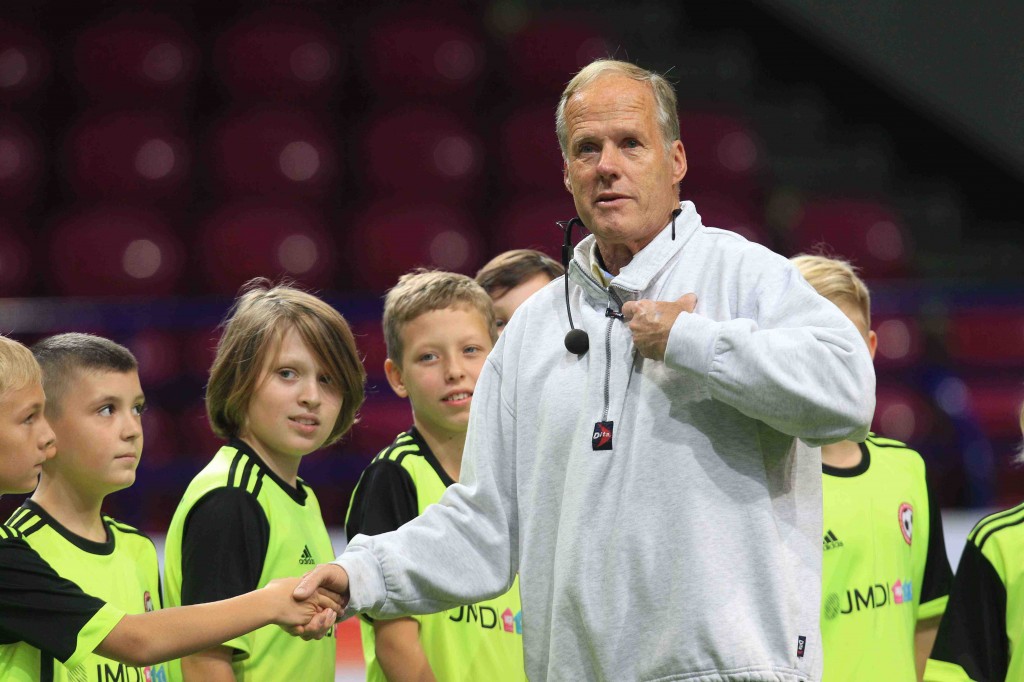
I pay my tribute to the Marcelo Bielsa of children’s football.

Horst Wein, who sadly passed away five years ago this month, has influenced thousands of coaches with his child-centred approach aimed at developing football intelligence among young players, particularly through a skilful application of small-sided games.

To celebrate the life of the charismatic, trailblazing, former ice hockey coach I have translated some of his perhaps less known quotes.

THE CHILD

The development of young footballers can be compared to a journey. Before it starts, you should first be introduced into a programme so that you know where it goes, you do not get lost and you do not needlessly waste time or energy.

The first key to success is an appropriate structure of football competition for children up to 14 years of age. You should strike a balance between the demands of games and the current mental and physical capabilities of every young player at a specific development phase.

Training and competition in children’s football should be exactly like their shoes – they should fit perfectly, be not too big nor too small, so that the child can move comfortably and feel good.

COACHING

One who wants to triumph in football must look for new ways, instead of always following the same route.

Almost everywhere youth coaches are more interested in the training content that in the way this content is best passed on to the players, so that effective learning takes place.

Not only the variety of ingredients in the menu (training session), but also the way in which the cook (coach) prepares and serves the menu determines the success or satisfaction of guests (players).

Practically, a good coach does not teach his players at all, but only helps themin learning and teaching processes – to discover by themselves what he planned in the content of exercises and simplified games. Constantly stimulating his pupils to think and act, rather than think for them, is a transcendental function of a good coach.

Exactly like in street football, in ‘mini’ football the coach has almost no significance. The less he instructs, the more experiences there are for the players who have time to discover the game by themselves.

The perhaps biggest problem in the development of young footballers is that a lot of young coaches know a lot about football. But their young pupils do not.

The effective learning through discovery begins when the coach, through problems he poses, understands that decisions which he used to teach himself are now left to pupils, as it was the case in street football.

A good coach does not teach his players almost at all, but only confronts his pupils with problems which are understandable and solvable for them, so that they can be solved as well as possible through their own discovery or with the coach’s help.

MOTIVATION

The more enjoyment and motivation there is, the more you learn.

ENTHUSIASM

Thanks to enthusiasm even the hardest job becomes a pleasure.

RESULTS

A youth coach who goes from victory to victory has done more for his own future that for the one of his young players.

MISTAKES

We should set ourselves long-term targets, so that we do not get frustrated with all those mistakes that arise while reaching the target in the short-term.

INFORMATION

The more a good coach knows, the less information he gives away.

INTELLIGENCE

In football, a milligram of brain weighs more than a kilogram of muscles.

CREATIVITY

The creativity of your pupils is the source from which the coach should drink every day.

FOOTBALL

You must respect football of the past, study football of the presence and anticipate football of the future.

Source: Horst Wein, “Spielintelligenz im Fussball”

Young January 2021 Signings

As the January transfer window is drawing to a close, I have picked some under-23 players who have been on the move this winter.

See: Young January 2020 signings

Leon Dajaku

Born: 12 April 2001

Nationality: German

Position: attacking midfield

From: Bayern Munich

To: Union Berlin (loan)

The highly-rated teenager made two substitute appearances for the European Champions last season, having signed for Bayern from VfB Stuttgart in July 2019. However, he followed it up with just a single German Cup first-team cameo in the first half of this season, so has now been loaned out to surprise Bundesliga-package Union Berlin, where he immediately played half an hour in a narrow, away defeat to RB Leipzig. Dajaku – of Kosovo Albanian descent – comes from the densely-populated Stuttgart region and joined VfB from local club FSV Waiblingen at the age of 13. He is reportedly a goalscorer, quick and with an eye for a pass.

Amad Diallo

Born: 11 July 2002

Nationality: Ivorian

Position: winger

From: Atalanta

To: Manchester United

Another teenager on this list, Diallo became the first player born in 2002 to score a goal in Serie A when he came off the bench for his senior debut and completed Atalanta’s emphatic (7:1) win over Udinese with a solo effort last season. The left-footer, a younger brother to Sassuolo’s Hamed Junior Traoré, was born in Abidjan and moved to Italy around the age of 10. “From the very first moment, it was evident the kid was special”, remembered Denis Cerlini, Amad’s coach at local club Boca Barco. “He was very bold and quick, possessed great technique and a strong shot, and executed everything at great speed. Amad was popular in the dressing room. He made a lot of friends, learned Italian and seemed to be a very determined guy who knew exactly what he wanted.” Diallo spent just a season at Boca Barco, before joining Atalanta at the age of 13. Manchester United have reportedly paid up to a staggering £37 million pounds for him.

Krépin Diatta

Born: 25 February 1999

Nationality: Senegalese

Position: winger

From: Club Brugge

To: Monaco

Also a winger, the 2019 African Cup of Nations best young player cost Monaco an impressive €20m, having spent the last three calendar years in Belgium and one in Norway before that. Diatta heavily featured in the Champions League group stage over the course of the last two seasons and is already on nine goals scored in the 2020/21 Jupiler Pro League campaign. Deployed at wing-back, too, he can be equally dangerous using either foot.

Michał Karbownik

Born: 13 March 2001

Nationality: Polish

Position: central midfield

From: Legia Warsaw

To: Brighton & Hove Albion

The 19-year-old was always expected to make it, according to one of his former coaches I spoke to at the Legia Warsaw Academy last season, once he joined the Polish Champions from local club Młodzik 18 Radom at the age of 14. The technically proficient Karbownik is a central midfielder by trade, although he has heavily featured at full-back in senior football so far. Versatility may aid his cause, as Brighton have perhaps surprisingly decided to bring the three-time Poland international over to England six months earlier than initially planned.

Kouadio Koné

Born: 17 May 2001

Nationality: French

Position: central midfield

From: Toulouse

To: Borussia Mönchengladbach (in the summer)

Another central midfielder here, Koné had already made 12 Ligue 1 starts by the outbreak of the coronavirus pandemic. He comes from the biggest talent pond in the world, one he left to join Toulouse no sooner than at the age of 15, having also trained at the prestigious Clairefontaine Academy. Tall, athletic and skilful on the ball, he will move to the Bundesliga in the summer for a reported fee of 9 million euro. In the meantime, he will be keen to drive his current club back into the top-flight.

Takefusa Kubo

Born: 4 June 2001

Nationality: Japanese

Position: attacking midfield

From: Real Madrid

To: Getafe (loan)

The former Barcelona youth team player scored once and provided three assists in the Europa League group stage, but made just two La Liga starts for Villarreal in the first half of the season. This was not enough for Real Madrid who brought the loan spell to an end and sent the young Japanese out to another Spanish top-flight club for the remainder of the campaign. A sign of high hopes and big things expected of Kubo in the future. For now, he has made a promising first impression at Getafe.

Jakub Moder

Born: 7 April 1999

Nationality: Polish

Position: central midfield

From: Lech Poznań

To: Brighton & Hove Albion

“WOJTEK!”, the 21-year-old midfielder shouted at Juventus goalkeeper Wojciech Szczęsny in one of his first training sessions with the Poland national team. The reason behind an animated reaction? He just wanted to get on the ball and start an attack from deep. Brighton reportedly paid €11m for Moder – who spent a season on loan at my hometown, second-tier club Odra Opole just two years ago – at the end of the previous transfer window and, having followed his progress in this season’s Europa League group stage, will now be hoping to integrate the central midfielder into the first-team set-up. He will certainly need to bulk up physically, but opponents will already have to beware of his strikes from outside the box!

Martin Ødegaard

Born: 17 December 1998

Nationality: Norwegian

Position: attacking midfield

From: Real Madrid

To: Arsenal (loan)

This is arguably the most high-profile signing of this January transfer window, even though, at least for now, only a loan one. Having been widely regarded as one of the best players of La Liga last season, the former Real Sociedad loanee did not manage to break into the Real Madrid starting line-up in the first half of this campaign. As a result, he will now be looking to refind his form in the Premier League. Ødegaard is said to be a product of his father, a former professional footballer and now a coach Hans Erik, whose then innovative individual training sessions were to propel his son into becoming one of the most talented teenagers in European football. Now it is time for the 22-year-old Martin to truly cement his reputation as a world-class player.

William Saliba

Born: 24 March 2001

Nationality: French

Position: central defender

From: Arsenal

To: Nice (loan)

Having somewhat bizarrely still not made his first-team Arsenal debut, the teenage centre back is back in Ligue 1. And already making an impression on loan at Nice. The early developer, who played at the under-15 level aged 12, was born in the suburbs of Paris and joined the Saint-Étienne Academy at the age of 15. Like Ødegaard, Saliba will be now hoping to restore his reputation before taking up a challenge of breaking through into the Premier League once more next season.

Dominik Szoboszlai

Born: 25 October 2000

Nationality: Hungarian

Position: attacking midfield

From: Salzburg

To: Leipzig

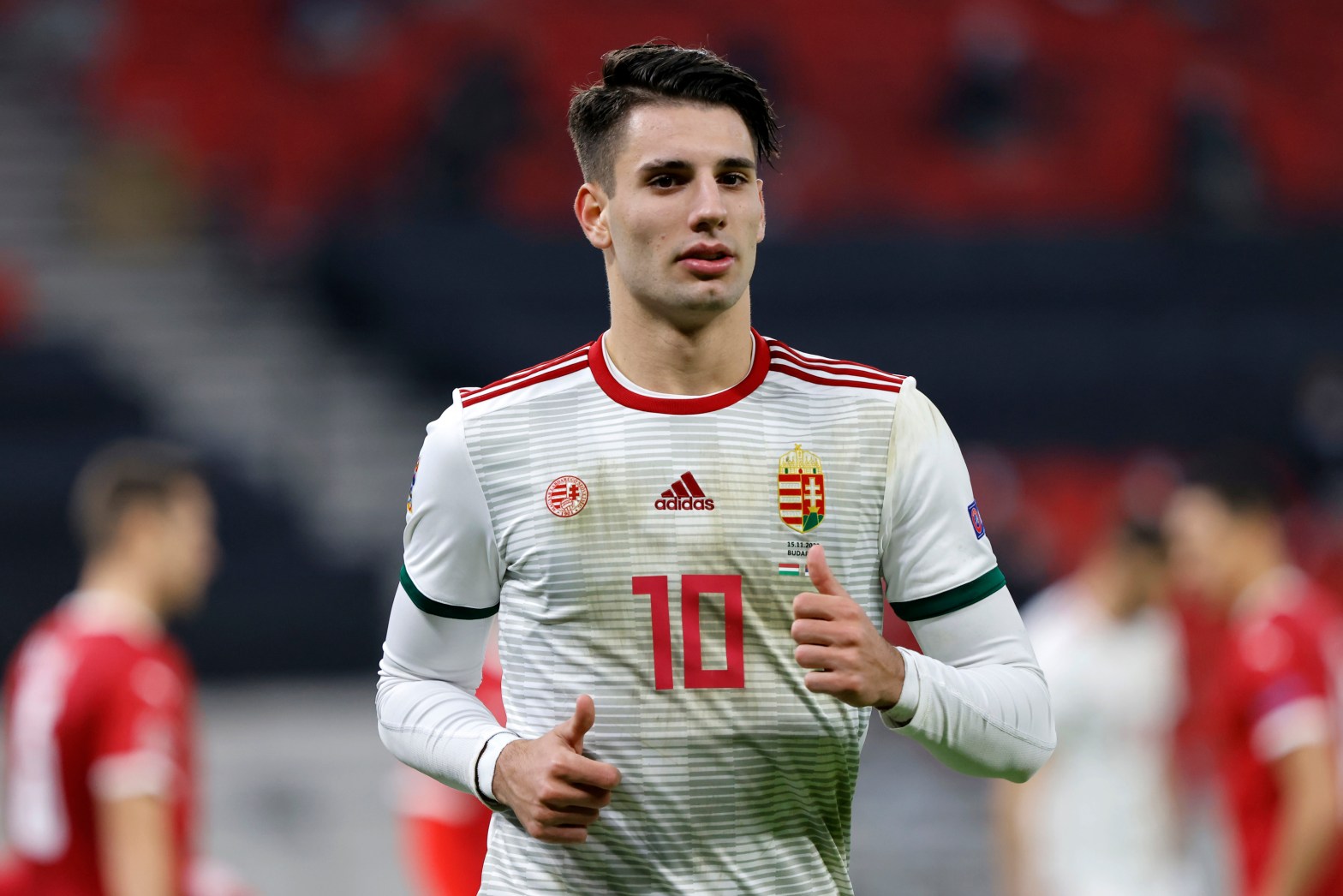
The impressive 20-year-old would have surely already made his Bundesliga debut had he not suffered an injury which ruled him out of action until at least the beginning of February. This has been a step by step career so far. Szoboszlai joined Salzburg via their feeder club Liefering at the of 16, having previously spent just a single season at MTK Budapest. The technically proficient difference-maker – especially at international level, youth and senior – will become another weapon for Julian Nagelsmann’s side in the years to come.

My Research: How It All Began

Since the start of 2020, I have been researching the beginnings of current young football stars. Here are some of the findings.

TALENT

Let’s put things straight. If you are to become a world-class footballer, your talent needs to be obvious from day one.

The first coach of Eduardo Camavinga says he has never seen another player like him and it is some claim from someone who has worked with youngsters for nearly half a century. Meanwhile, four-year-old Kai Havertz was reportedly so good with a football at his feet that his local club made an exception by allowing him to join in training sessions a year ahead of when it was allowed for anybody else. As another striking example, Ansu Fati left everybody astonished when turning up on the football pitch for the first time in the Andalusian town of Herrera.

Nothing other than talent represents the all important first step.

PASSION

As perhaps everybody knows, talent is not enough though. It is one thing being talented. Another is being talented AND have a passion.

According to the Birmingham City Academy coaches, Jude Bellingham always stood out for passion first and quality second. Mason Greenwood would arrive first at every training session, honing his skills before practice began. Mason Mount‘s father claims he could probably count on one hand all sessions his son missed as a child. He did not even bother going to school parties. All he ever wanted to do was go training.

Passion will get you one step further.

MOTOR SKILLS

Then, you need to add motor skills – often seen as the base of the player development pyramid – into the mix.

Nine-year-old Eduardo Camavinga was quick and agile. Ferran Torres was also quick. Jude Bellingham was very agile. Mason Greenwood‘s pace was such he apparently broke the Great Britain 100m sprint race record at under-13 level.

In fact, some current footballers thrived at other sports, too. Both Lautaro Martínez and Giovanni Reyna played competitive basketball even in their teenage years, before choosing football as their number one sport.

FOCUS

Time for perhaps less obvious factors.

Eduardo Camavinga has also been remembered as a serious kid, always on time for training. Ferran Torres was humble and introverted. Mason Mount, again, just wanted to train.

It may be strongly linked to passion, but you need to be focused.

CONFIDENCE

Another thing is being naturally confident.

Rayan Cherki would frequently produce rabonas even at youth level. Ferran Torres has been described as a bit cheeky. The remarkable numbers of footballing talent emerging from South London could be attributed, among many other factors, to the confidence of the players raised in this particular area of the world.

QUICK LEARNERS

The best are not only passionate, focused and confident. They also tend to learn quickly.

They see a problem as a challenge rather than a negative, as former head of coaching at the Swansea City Academy put it. Meanwhile, as soon as you showed Mason Greenwood anything new, he would just do it straight away.

SIBLINGS

Let’s move into even less obvious aspects, however.

It remains striking just how many of the elite sportsmen tend to have a lot and, in particular, older siblings.

Eduardo Camavinga is the third of his parents’ six children while Rayan Cherki is the third of five. Lautaro Martínez has both an older, who is also a footballer and a younger brother, who plays basketball. Ferran Torres is the middle one of three children in his family, too. His older sister would often give him a lift to the Valencia CF training base when he was not yet allowed to drive. Kai Havertz is the youngest of three children in his family. He lived with his older brother, who was studying in Cologne at the time, upon leaving his maternal town to join Bayer Leverkusen as a teenager. Six-year-old Ansu Fati turned up at his first training session alongside his older brother. Mason Mount has an older sister who he would use as a target when kicking a ball all around the house. Giovanni Reyna claims it was his older brother rather than any of his parents, who both represented their country at international level, who taught him everything. Finally, Reece and Lauren James also have an older brother.

ADVERSITY

It also seems remarkable how many of the best footballers had to come through some bad experiences.

The family of Angola-born Eduardo Camavinga once lost everything when their house was destroyed by a fire. Ansu Fati, who moved over to Europe from Guinea-Bissau at the age of six, was barefoot and wore swimming trunks during his first training session. Jamal Musiala also moved to another country at a young age while Marcus and Khéphren Thurams saw their parents divorce. Meanwhile, Lautaro Martínez was homesick when he first left his home. Still, that was all nothing compared with the traumatic experience of nine-year-old Giovanni Reyna whose older brother Jack, the one who taught him everything, died from brain cancer at the age of 13.

Dealing with adversity often breeds determination which is, of course, another common theme of the two biggest talent ponds in world football: Greater Paris and South London. Past experiences, along with environment, matter.

SUPPORT

Things are perhaps less unambiguous when it comes to support provided to the stars of the future. Some got a lot of it. Others less. Some experienced at least some pressure to make it. Others none whatsoever.

The commitment of Mason Mount‘s parents was incredible, driving his son from Portsmouth to West London four times a week for a number of years. Eduardo Camavinga was registered at his first club by his mum who, as it often starts, got tired of her son breaking everything in the house while playing football. On the other hand, some time later upon the family’s house getting totally destructed by a fire, Eduardo’s father reportedly told his son he was the hope of the family. Meanwhile, Reece and Lauren James’ father was an unfulfilled ex-footballer and coach, who was focused on discipline before anything else.

Others provided advice rather than pressure. Erling Haaland remained at his boyhood club until the age of 16. It was only then when his father, former Norway international Alf-Inge, demanded that his son made a move to Molde. Another ex-footballer, Claudio Reyna, insists he did nothing to hone Giovanni‘s footballing ability. He played with his brother in the garden, he recalls. Lilian Thuram went one step further claiming he did not want any of his sons to become footballers, even initially taking them to judo and fencing sessions instead!

The amount of support provided by coaches also tends to differ.

According to George Lappas, one unnamed current international footballer was once on the verge of being excluded from his club. His coaches gave him one last chance. Meanwhile, Birmingham City Academy coaches admit they would challenge Jude Bellingham by providing him with a lot of support on some occasions and no support other times.

COACHING

As for the quality of coaching, there are different ways, too.

The first coach of Rayan Cherki believes the kid was already so good at the age of six, there was nothing he could teach him. Mason Greenwood was given little challenges rather than huge pieces of advice. Nigel James, however, was keen to teach his children the standards they should aspire to, providing sessions for them in the family back garden.

A more open way of coaching, emphasising creativity over obedience, is also credited to have influenced the success of both South London and Paris footballers. Jonathan Ikoné even recalls how Wilfried Mbappé, his ex-coach and father of Kylian, would take him off the pitch when he did NOT attempt a one-v-one in a match!

RELATIVE AGE EFFECT

As for RAE, my conclusions are actually very simple. If you are very talented from an early age, it does not matter what month you were born in.

In fact, Eduardo Camavinga and Giovanni Reyna were both born in November whereas Ansu Fati was born on 31 October. Meanwhile, Jude Bellingham was born at the end of June, i.e. the 10th month of the English school year.

What is more, the likes of Erling Haaland, Kai Havertz and Bellingham were small, if not very small, physically until the age of about 14-15. That never stopped them from playing in older age groups as children, though.

SCOUTING

Finally, you may be wondering, where do the most talented young footballers of the new generation come from? Small towns? Or big cities?

You are unlikely to be surprised that my research has so far shown that they could be born anywhere. But increasingly in towns rather than cities.

Eduardo Camavinga was raised in Fougères, a town of around 20,000 inhabitants in northwestern France. Erling Haaland grew up in Bryne, an even smaller town in south-west of Norway. Kai Havertz is from Alsdorf, 15 kilometres north from the city of Aachen. Ansu Fati came to the attention of first Sevilla and then both Barcelona and Real Madrid scouts when playing football in the provincial town of Herrera. Bradford-born Mason Greenwood showed his remarkable talent in the Manchester United development centre in Halifax. Jamal Musiala also started locally, at TSV Lehnerz. Ferran Torres comes from a town very close to Valencia. Jude Bellingham is from one 12 miles west of Birmingham.

There are exceptions, of course. Lyon-born Rayan Cherki has been at his current club since the age of seven. Mason Mount‘s Portsmouth is a city. And then both the suburbs of Paris and South London are parts of two of the biggest metropolis around the globe, after all.

In the picture (found here): nine-year-old Eduardo Camavinga honing his heading skills
My Research: Champions League Group Stage

A total of 179 under-23 players, born in 1998 or later, took part in the 2020/21 Champions League group stage, making up nearly 25% (out of 718) of all players who have so far made at least one appearance in this season’s competion proper.

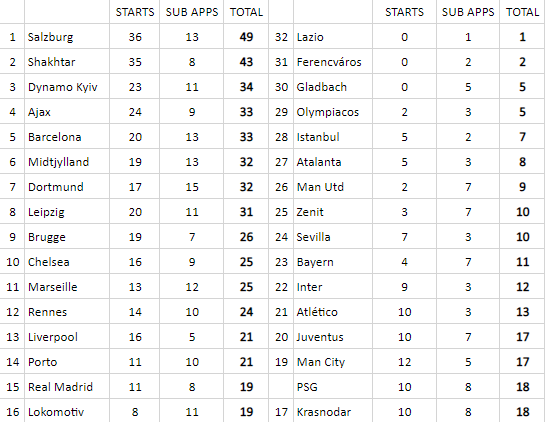
Shakhtar Donetsk fielded the most under-23s (11), just ahead of Barcelona, Borussia Dortmund and Salzburg (10 each). In contrast, Borussia Mönchengladbach, Ferencváros and Lazio only used one player born no earlier than in 1998 each.

Meanwhile, Salzburg finished top when it came to the total number of appearances made by under-23 players in this season’s Champions League group stage. Lazio were bottom.

A summary of all appearances made by under-23 players in this season’s Champions League group stage.

The total of 179 under-23 players, who have made at least one appearance in the elite competition so far this term, represent 41 different nationalities.

France lead the way with 19 under-23s, ahead of England (17), Brazil and, perhaps surprisingly, Russia (15). Spain come fifth with 13, closely followed by Ukraine (12) and the Netherlands (11). Germany are eighth, level with Portugal (8 each). The United States are tenth (7) and Italy are eleventh (5).

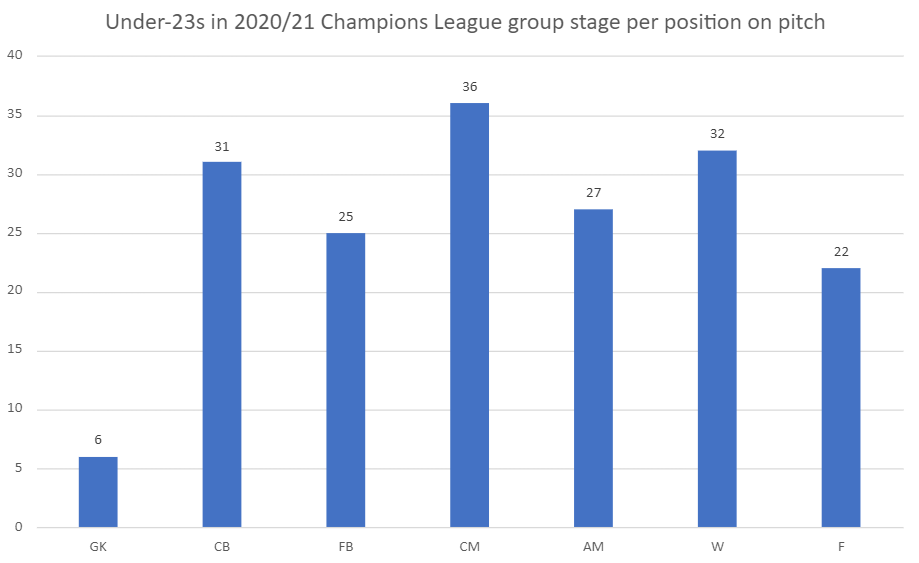
As far as position on the pitch is concerned, under-23s in this season’s Champions League group stage are statistically almost never goalkeepers.

Furthermore, out of 179 under-23 players who have made at least one appearance in the Champions League proper so far this term:

They also scored 20% (58 out of 289) of goals, assisting 12% (36).

See the best young individual performers of this season’s Champions League group stage [a thread].

In the picture (found here): Dynamo Kyiv’s Ilia Zabarnyi is the youngest player to have played every minute of this season’s Champions League group stage

All data presented in this article comes from my own research supported by WhoScored.com and Transfermarkt.com.

Design a site like this with WordPress.com
Get started