The club academy’s former head of coaching outlines the importance of the mental aspect and mentoring of coaches in player development.
It could be argued that no club in British football have had a more defined playing style in recent times than Swansea City – despite Roberto Martínez back in the late 2000s remaining the last head coach to stay at the Liberty Stadium for a spell of over two years!
With their seven-year-long stay in the Premier League having come to an end two seasons ago, Swansea have since found themselves in the top half of the Championship table but so far short of fulfilling their ambition of a swift return to the top-flight.
Under-17 World Cup winner with England Steve Cooper replaced Brighton-bound Graham Potter as head coach last summer and the team have featured a noticeable number of youngsters this campaign.
Cooper’s former charges in Conor Gallagher, Rhian Brewster and Marc Guehi – all part of England’s World Cup success at youth level back in 2017 – moved to South Wales on loan deals in January.
Meanwhile, the club academy’s youth products such as Ben Cabango, Brandon Cooper (both also born in 2000), Liam Cullen (born in 1999), Joe Rodon (1997) and Connor Roberts (1995) have all been part of the first-team set-up.
Curiously, centre back Rodon and striker Cullen have both been at the club since the age of eight whereas Cooper – another central defender – joined their academy aged six.
MENTALITY
“They are all hard-working individuals who are strong believers in their own ability“, ex-head of coaching at the Swansea City Academy Roy Thomas told Breakthrough.
“All four [including Roberts] have good personalities and are good guys.
“They are all well-rounded and have always helped me when I asked them, for example attending foundation and youth phase sessions at the academy to support young players.”
Thomas, who oversaw the club’s academy achieving the Elite Player Performance Plan (EPPP) Category 1 status in recent years, regards mentality as the most underestimated aspect of coaching.
“The personality of a player is sometimes overlooked by the recruitment system with scouts looking at physical attributes of players rather than the person”, he added.
“I believe this is as important or [even] more important than natural talent.”
From his experience, approximately 10% of a squad of 18 under-9 players will go on to obtain an under-18 scholarship.
“It is difficult to estimate”, Thomas said when asked whether there were any particular psychological or social traits he would deem as crucial.
“But one thing I look for is the readiness to improve and get better.
“[I like] A young player who sees a problem as a challenge rather than a negative.”
Thomas, who had previously worked as Technical Director for Football Federation of Australia, lists factors such as coaching, parents, home environment, school, peers and outside influences, girlfriends, finance and luck as all having a potential input into player development.
As for coaching, in his view, there is one particular thing that should always be remembered.
“They [the players] like making friends and learning new things”, he says. “Most important [is that] they are having fun.”
MENTORING
In his time at Swansea, whom he joined back in 2012, Thomas put particular emphasis on the development of not just exciting young players but also high-quality youth coaches who would be in line with the club’s philosophy and support every youngster on their journey.
While players carried out their personal development plans, coaches themselves were going through their own specific mentoring programme.
“The coaching philosophy in particular has always looked at producing exciting players while also allowing them to become more independent decision-makers“, Thomas also told Breakthrough.
“All sessions provide on average 80% ball-rolling time, with less interventions from the coaches.”
As far as the foundation phase is concerned, it seems it is all about providing players with a wide variety of technical elements.
“The foundation phase coaching curriculum, in which I have been responsible for, focuses on repetition“, Thomas added.
“Every practice should include [1] striking and controlling the ball from and over short and longer distances, [2] attacking and defending as an individual, [3] crossing, finishing and scoring goals, [4] dribbling and running with the ball.
“In particular, [there should be] various volleying of the ball [such as] half-, side- and full-volleys, longer and shorter range passing, bending, dipping, curling the ball; 1v1, 2v1, 2v2 [games] with keepers, protecting the ball.
“All these, I believe, are extremely important in a player’s development.
“Goalkeeping [should also be] included as much as possible.
“All sessions must be safe, fun and have targets while being competitive with high tempo and realism.
“But having the right coaches and staff is vital.”
From Martínez, through Brendan Rodgers and Michael Laudrup, to Potter and Cooper coaches have always been key to Swansea City’s rise, success and destiny.
At Academy level – and their foundation phase – it appears to be no different.
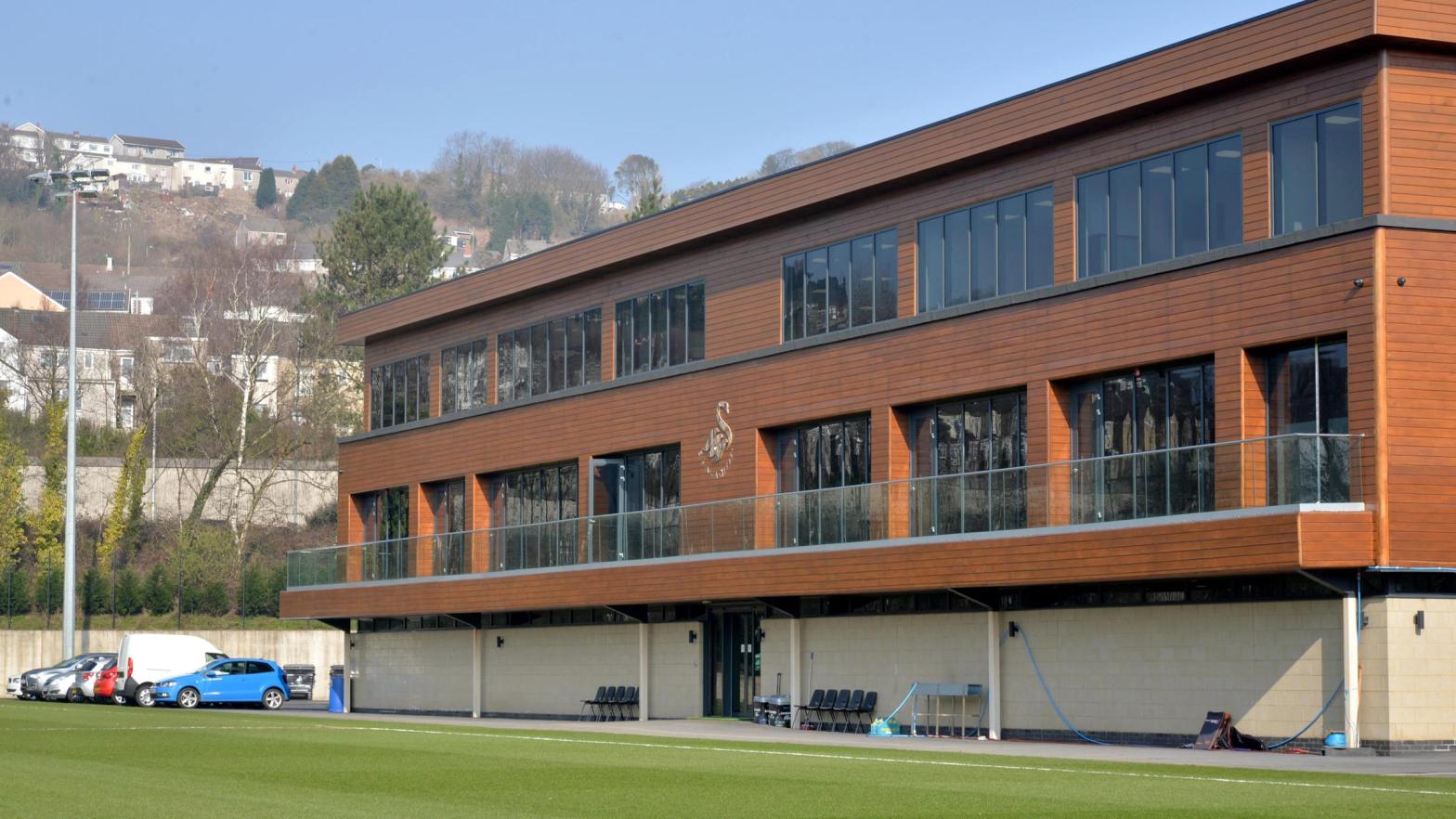
In the picture: Swansea City opened their new academy training complex facilities back at the start of the 2013/14 season (found here)
 BREAKTHROUGH