He always fought like a lion and was as quick as a flash.
“Four? You can forget it”, Dirk Morfeld remained firm on the club’s principles.
But the late Gerd-Willi Kämmerling kept insisting.
“Take one look at him”, the long-standing member of the same club told his younger colleague. “He is quick, he is good on the ball.”
RECOGNITION
In 2018, Sportverein Alemannia 1916 e. V. Mariadorf, to give the club their full name, were awarded an official certificate from the German Football Association.
It read: […] In recognition of this outstanding work developing young talent, the German Football Association award this distinction, which is combined with a grant of €6,875 to the youth department [of the club].
This is how the governing body of German football appreciate the influence of clubs, who made a valuable contribution to the development of an up-and-coming young player.
No matter at what age the player was registered with a club.
The Fritz Walter Medals, awarded to the best youth footballers in Germany since 2005, recognise not just the top football prodigies in the country, but also the clubs that played their part in the remarkable development of the most outstanding talents.
So when Kai Havertz received his gold medal, named after the legendary 1954 World Cup-winning captain, as the best under-19 footballer in Germany during the 2017/18 season, the club where he started his career were also rewarded*.
Even though the current Bundesliga star’s very first coach eventually abandoned his golden rule.
LIKE A FLASH
Kai Havertz was born in the historic city of Aachen in the North Rhine-Westphalia region of West Germany and grew up less than 15 kilometres north, in the town of Alsdorf.
This is where he was first seen with a football at his feet by Kämmerling, these days regarded as the real discoverer of the now Germany international’s talent.
There was only one problem.
Local club Alemannia Mariadorf would not allow children younger than five years of age to train with them. Kai was four when Kämmerling took notice of him back in 2003.
Did the club feel four-year-olds were simply too young to train football?
Possibly.
More importantly, though, there were simply too many four-year-old kids – or parents of four-year-old kids, rather – who wanted to join the club.
“He would fit perfectly in the team“, Kämmerling, who worked at his beloved club in various capacities, told Morfeld, himself coaching the youngest age group at Mariadorf at the time.
Despite the initial reluctance to disobey the rule, Morfeld ended up making an exception for little Havertz.
He would not regret it.
“I allowed Kai to join in training with us and thought: ‘unbelievable‘”, the current Bayer Leverkusen playmaker’s first coach, who still works at Alemannia today, remembers.
The little Havertz was never the best player on the team and understandably so. He would train with kids a year or even two years older than him. As with Erling Haaland, he was also pretty small (and would not significantly grow until the age of about 15-16).
However, Kai would still stand out. More than anything, with his will and drive.
“He always only wanted to play football and never let himself get distracted, did no silly things, was always single-minded“, Morfeld explained.
“This makes the difference, I thought it already then.
“He always fought like a lion and was as quick as a flash.
“He could strike the ball well, was modest and always polite.”
GARDEN GNOMES
Apart from Kämmerling and Morfeld, it seems the now 20-year-old has a lot to thank his maternal grandfather for.
Richard Weidenhaupt-Pelzer was once a footballer himself, plying his trade for Dutch Roda Kerkrade.
He was also probably the first person to play football with little Kai and would allow the boy to hone his accuracy by knocking garden gnomes off a wall in the family garden.
(Note: Kai Havertz has an older sister and an older brother. His mother is a lawyer and his father works as a policeman.)
ONE EXCEPTION
Similar to Eduardo Camavinga, Havertz stayed at his local club for several years before making a move to the other Alemannia. He spent just a single season at the Aachen-based club, though, and joined Bayer Leverkusen at the age of 11.
(He scored a hat-trick against Leverkusen for Aachen while already playing for their U12s.)
Seven years earlier in his home town, his soon-to-be first coach tended to remain firm on the principles of a local football club.
Good job he did make that one exception.
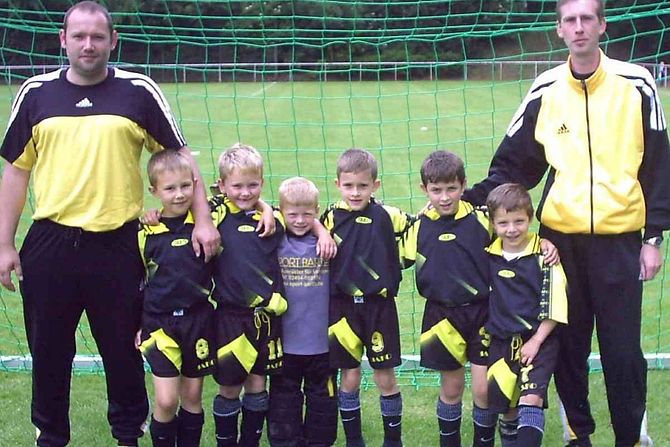
In the picture: Kai Havertz was the smallest player on the team at Alemannia Mariadorf, Dirk Morfeld stands on the left (found here)
* In total, Alemannia Mariadorf have already received around €30,000 for the fact Havertz was once on their books, including a training compensation from Bayer Leverkusen and further money from the German Football Association once the player made his debut for the senior national team as well as won the Fritz Walter Silver Medal at the under-17 level. The income has so far been reinvested – among other things – into redeveloping the club’s changing rooms. Further injection of finance is expected when Leverkusen sell Havertz in the future.
 BREAKTHROUGH