
It was maybe a good thing for him to be smaller.
It may be difficult to believe, but Europe’s top goalscorer so far in 2020 has not always been the tallest player on his team. And not only due to the fact he tended to play a year above his age group.
In fact, as a child, Erling Haaland used to be – apparently – quite small.
Running in behind
Despite standing at 194 cm (6 ft 4 in), the 19-year-old Norwegian forward could probably be deemed almost anything but a traditional number nine.
Just take a look at his first eight goals – in four appearances, three of which off the bench – for Borussia Dortmund.
There were close-range finishes, shots on the half-turn and one-v-ones with the goalkeeper after running in behind the opposition defence.
Not a single header.
“He was always good when he was younger, he had qualities and you could see his talent”, said Haaland’s former teammate at Bryne FK Tord Salte. “He was quick and very clever in terms of the timing of his runs and going in behind. He always had that… His problem was just that he was actually very small.”
A late developper, who only grew tall around the age of 15-16, used his modest height (and weight) to his advantage, though.
“It was maybe a good thing for him to be smaller,” added the centre forward’s ex-coach Alf Ingve Berntsen. “because when he was 11, 12, 13, he had to be clever in the box, he had to be smart to create chances, and we can see that today. Even though he is a big guy, he moves really well and his positioning is very good. Maybe that is from an early age when he had to play with older, bigger guys.”
Fun environment
Today, Haaland seems a fiercely competitive player on the pitch and a relaxed, smiling person off it.
This could almost certainly be owed to his upbringing in native Norway.
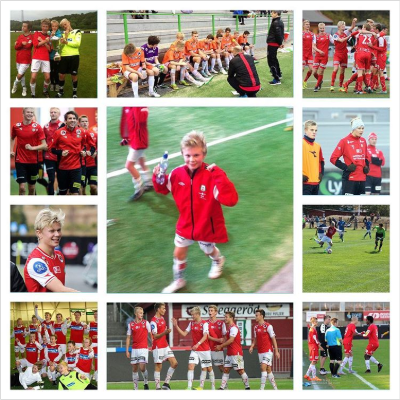
The Dortmund striker, who was born in Leeds but moved to his home country as a three year-old, played at local club Bryne (a town of around 12 thousand inhabitants) FK from the age of 6 to 16.
He never tasted a professional academy’s set-up.
Instead, for 10 years, he trained – although a year above his age – in a group of about 40 players of mixed abilities, who were then split for ‘A’ and ‘B’ teams for games.
Furthermore, they would all meet up at weekends in an indoor hall in the town to play together. Without coaches nor parents.
You could probably call it one of those tightly-knit communities, where everyone simply enjoyed themselves. And their football.
Father’s influence
Of course, Erling has not done it all by himself.
He could – and would – always count on his father.
“I never got the impression, even for a second, that he put pressure on Erling“, Berntsen said of Alf-Inge Haaland, ex-footballer for the likes of Nottingham Forest, Leeds United, Manchester City and Norway himself.
The father only intervened when his son turned 16, at which point he thought Erling should leave Bryne and start a more independent life – and career – at Molde.
In fact, as Alf-Inge remembers, the teenager then asked him: “why am I moving so early?”
The older of the Haalands has also taken care of his son’s following two January moves – first to Salzburg and now Dortmund – making sure his career path would take several small steps rather than one big.
Erling used to be small, remember.
In the picture: Erling Braut Haaland was having fun on social media while considering which big club to join in this year’s January transfer window
 BREAKTHROUGH