Since the start of 2020, I have been monitoring the progress of young players in Europe’s top five leagues. The coronavirus pandemic has provided an opportunity to sum up some of the very first findings.
This time, I have looked at nationalities of under-23 players (born in 1997 or later) who directly influence the outcome of games, i.e. score and assist goals across Europe’s top five league competitions.
As for players holding more than one passport, their nationality was decided upon the country they have most recently represented or currently remain eligible for at international level. English, Scottish, Welsh and Northern Irish nationalities are treated separately.
Let’s begin by looking at goalscorers.
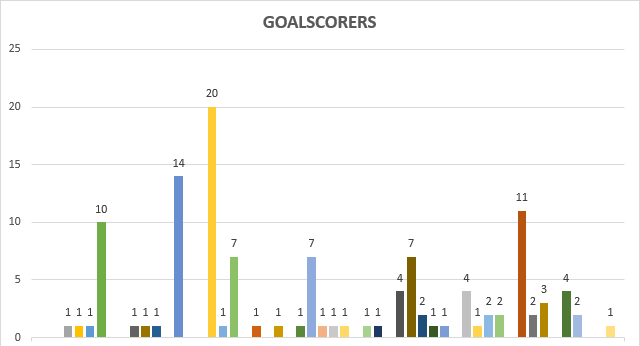
Under-23 players of 35 different nationalities have scored goals in Europe’s top five leagues so far in 2020.
The cumulative number of under-23 goalscorers per nationality across Europe’s top five leagues so far in 2020.
France is leading the way with 20 different under-23 goalscorers across Europe’s top five leagues so far in 2020 and is also the only nation to boast at least one under-23 goalscorer in every one of the five league competitions since the beginning of January.
England comes second with 14 different goalscorers across the Premier League, Ligue 1 and the Bundesliga. Spain – on 11 – and Brazil – on 10 – are third and fourth respectively.
Germany, Italy and the Netherlands all have seven different under-23 goalscorers.
Morocco, Portugal and Turkey are all on four; Switzerland has three; Nigeria, Senegal, Serbia, Sweden and the United States are all on two; Argentina, Austria, Belgium, Colombia, Croatia, Denmark, Gambia, Greece, Hungary, Ireland, Ivory Coast, Jamaica, Japan, Macedonia, Mali, Northern Ireland, Norway, Scotland and Wales all have one each.
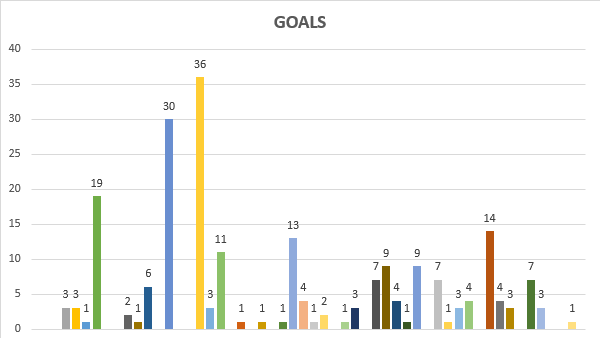
The cumulative number of goals scored by under-23 players per nationality across Europe’s top five leagues so far in 2020.
France also sits top when it comes the total number of goals scored by its under-23 players across Europe’s top five leagues so far in 2020.
England is again second, with Brazil (on 19 goals) ahead of Spain (14), Italy (13) and Germany (11) in third.
The Netherlands and Norway – or Erling Haaland in fact – are joint-seventh on 9 goals.
Morocco, Portugal and Turkey are behind them with 7 goals each while Denmark – read: Kasper Dolberg – has six.
Ivory Coast (all scored by Jérémie Boga), Nigeria, Serbia and Sweden are all on four goals each; Argentina (all by Lautaro Martínez), Austria, Gambia, Mali, Senegal, Switzerland and the United States on three; Colombia and Japan on two; Belgium, Croatia, Greece, Hungary, Ireland, Jamaica, Macedonia, Northern Ireland, Scotland and Wales on one.
Let’s now move onto goalscorers and assist makers.
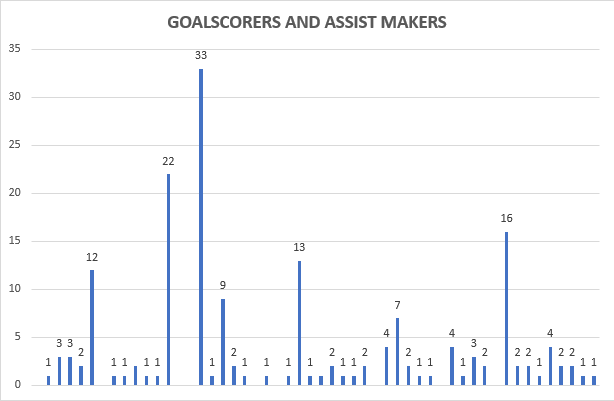
The cumulative number of under-23 goalscorers and assist makers per nationality across Europe’s top five leagues so far in 2020.
In total, under-23 players of 44 different nationalities have scored or assisted at least one goal across Europe’s top five leagues so far in 2020.
France has 33 different goalscorers and assist makers, again and exclusively in all five of the Premier League, Ligue 1, La Liga, Bundesliga and Serie A.
England is again second on 22. Spain is third (on 16), ahead of Italy (13) and Brazil (12).
Germany is sixth with 9 different goalscorers and assist makers. The Netherlands is seventh with seven of them.
Morocco, Portugal and Turkey are all on four; Argentina, Austria and Senegal on three; Belgium, Croatia, Ghana, Japan, Mali, Nigeria, Serbia, Sweden, Switzerland, the United States and Uruguay on two; Algeria, Canada, Colombia, Denmark, Ecuador, Gambia, Greece, Hungary, Ireland, Ivory Coast, Jamaica, Luxembourg, Macedonia, Northern Ireland, Norway, Scotland, Togo, Venezuela and Wales on one.
The cumulative number of goals scored and assists made by under-23 players per nationality across Europe’s top five leagues so far in 2020.
As far as the cumulative number of goals scored and assists made by under-23 players across Europe’s top five leagues so far in 2020 is concerned, France is again top on 72 with equal numbers of goals scored and assists provided (36 per each).
England is second on 57, with Brazil (26) just ahead of Spain (25) and Italy (24) in third. Germany is sixth on 21 goals.
Morocco (14) and Norway (10 – all down to Haaland and, surprisingly, none by Martin Ødegaard) are also into double figures.
Netherlands then follows with nine goals, edging Denmark (still all thanks to Dolberg), Portugal, Senegal and Turkey that are all on eight.
Austria has six; Argentina, Ivory Coast (100% by Boga), Nigeria, Serbia, Sweden and Switzerland all have five each; Gambia (all by Musa Barrow), Japan, Mali and Uruguay have four; Croatia and the United States – three; Belgium, Colombia, Ghana and Venezuela – two; Algeria, Canada, Ecuador, Greece, Hungary, Ireland, Jamaica, Luxembourg, Macedonia, Northern Ireland, Scotland, Togo and Wales – one.
In the picture: Jérémie Boga, who was born in Marseille and represented France at youth level but then made his senior international debut for Ivory Coast, has scored four and assisted another goal for Sassuolo so far in 2020 (found here)
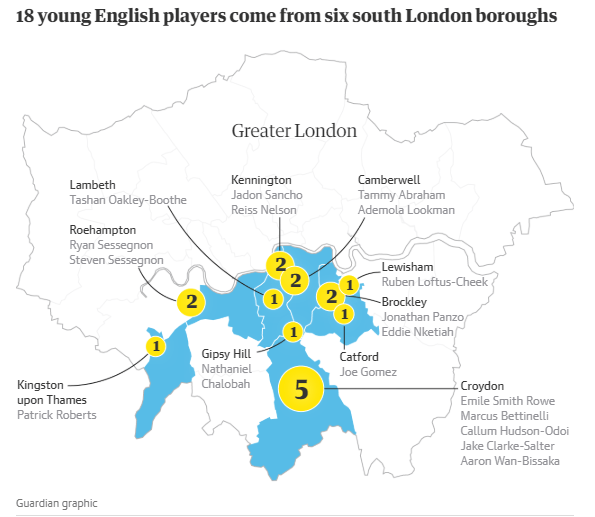
Yet, it was also widely reported that in 2016 outof all English players to feature in the Premier Leagueno less than 14% were born in South London.
The likes of Jadon Sancho, Tammy Abraham, Joe Gomez, Aaron Wan-Bissaka, Callum Hudson-Odoi, Ryan Sessegnon, Reiss Nelson and Ademola Lookman are all South Londoners.
No wonder this relatively small area of the British capital has earned comparisons with the suburbs of Paris.
MULTIETHNICITY
Similarities seem obvious.
London and Greater London boroughs situated south of the river Thames form a densely-populated area of over 2.8 million people, making up around a considerable 5% of England’s whole population.
The more people, the more footballers. And the more footballers, the more good ones.
Coming, originally, from all over the world, of course.
“I do think that at the centre of the excellence that comes out of South London is multiethnicity and I think there is more multiethnicity in that part of London than there possibly is anywhere else”, believes former Crystal Palace chairman Simon Jordan.
The Afro-Carribean immigration to South London is said to have led not only to a remarkable cultural diversity within that particular area but also, inevitably, to poverty. And all the things connected to it.
Including playing football.
MENTALITY
“If I understand well, you say to me that there are areas where people are more hungry for success than others”, points out Arsène Wenger. “And I say yes.”
“What is really interesting about the South London kids, like Jadon [Sancho] and Reiss Nelson, is that they all possess a mindset that I see with the best footballers in the world“, says Andy Ansah, himself a South London-born ex-footballer, more recently known as a football choreographer working with the likes of Ronaldinho, Ronaldo and Wayne Rooney.
“That [mindset] is a single-mindedness, a confidence, not an arrogance, which they put out there knowing that they can do what they say they can do.”
Former Crystal Palace striker Clinton Morrison provides a perhaps radical example of the natural confidence of South London-bred footballers.
“I always remember when I was sixteen and [played for] the Crystal Palace youth team”, he recalls.
“We had a youth team game in the morning and I scored a hat-trick.
“Then we always used to go to first-team duty.
“Imagine we were in the first-team dressing room, swapping out of the kit and just before the game I was saying to Bruce Dyer, who was the first million pound striker at Crystal Palace, as he was going out to play the game: ‘Oh, I scored a hat-trick today, I’m coming for your position!’ And I said it in front of the manager!
“That was the confidence I had in myself. I believed that when I went out there I was going to produce. In the end, it worked out for me.”
Hunger and confidence are two mental aspects. Resilience is another one.
“If you hold onto the ball for too long […] they’ll knock you down without even thinking about it”, Rio Ferdinand has written in a letter to his younger… self.
“You’re going to get tackled and you’re going to get pushed to the ground.
“You’re going to think to yourself: ‘Man, I don’t know if I should be here…’
“But listen to me, Rio. When this happens, I want you to do two things.
“Get up.
“Then, look right back at them and say: ‘Gimme the ball again’.”
CAGE FOOTBALL
The right mentality can help you go far.
As long as it is supported by a required set of skills.
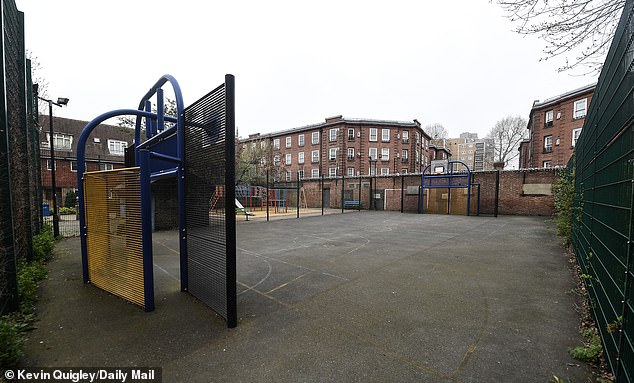
South Londoners believe that there used to be no better place to develop your footballing ability than in the so-called cages, preceding the more modern, small-sized pitches that can be found in today’s goal centres.
“It was all about being that showman in the cage, being the one”, Andy Ansah remembers.
“Even when we played multiple games, like three on three, it was all about twisting people up.
“What cage football does is it gives you the chance to home in your skills in tight spaces and have loads of touches.”
“There could be about 30 players on the pitch and that meant that when you got the ball it was not about trying to score, you wanted to stay on the ball for as long as possible“, adds David Powderly, the former Charlton Athletic and now England coach at youth level.
Cage football, where nutmeg is king, is said to be giving young boys an opportunity to express themselves.
And this is something of particular importance in flamboyant South London.
“It’s the swag and that’s a big thing in South London”, explains Andy Ansah.
“When you go onto the football pitch, it’s a level-playing ground and it’s a chance for you to show what you can do and stand out.
“There’s a massive respect and appreciation for ballers in south-east London. No matter what age you are, there’s a huge respect that comes with it, huge.
“I think that’s another thing that drives these South London kids to be the best on the football pitch.
“This is why every club in the country is setting up satellite centres in and around south-east London or got scouts around there, trying to get these kids and give them an opportunity.”
SCOUTING
As with Greater Paris, the growing prominence of South London – and its talents – on the footballing map has not gone unnoticed.
Scouts are everywhere.
In the EPPP era, football clubs are keen on signing the most promising-looking players as early as possible.
Jadon Sancho trained at the Watford Academy from the age of seven while his football brother Reiss Nelson joined Arsenal around the same time.
Meanwhile, Ryan Sessegnon was eight when he first played for Fulham and Callum Hudson-Odoi has been at Chelsea since the age of six. Tammy Abraham turned blue as a seven-year-old.
Staying in South London, Joe Gomez signed for Charlton aged 10 and his peer Aaron Wan-Bissaka joined Crystal Palace a year later.
However, grassroots football has remained strong south of the Thames, providing an opportunity for late-developers as well as players who simply entered the game at a later stage of their childhood.
An example of this, Ademola Lookman only moved to Charlton from local club Waterloo at the age of 16.
COACHING
Just as in Paris’ banlieues, South London always seemed to produce very good footballers – from David Rocastle and Ian Wright, through Rio Ferdinands and Wilfried Zahas, to the most recent generation of England under-17 and under-20 World Cup winners.
Just not so many of them.
So what is the key reason behind the emergence of – arguably – another powerhouse of European and world football?
Some believe it to be coaching.
“A lot of the old school methods of coaching were very autocratic and based around the coach having all the answers”, explains former Crystal Palace academy coach Harry Hudson.
“That immediately set the environment for the session and for an interaction between a coach and a player.
“If the coach wants things to be very orderly, very structured, for him to have the answers, he’s not going to want any type of wild card in there, any type of threat or risk towards that order.
“And young players from South London do have a swagger, a confidence and a will to test coaches.
“And a lot of coaches don’t like that because it affects their ego and potentially questions their place within the group.”
Especially in England, in no small part to the coaching education system led by the Football Association, this seems to have changed.
And considerably, too.
“They can be themselves“, agrees David Powderly.
“They can make it for how they’re playing outside [of clubs].
“That’s the key now. If they come in to our training sessions and don’t feel they can do what they can do out there, it’s the wrong environment.
“You’re coming in because of that. I don’t want to change that when you’re in here.
“We just have to create the way of playing, okay when or where to do it, but certainly at young level I want to see it more. We say: ‘don’t bore me!‘
“‘I get excited when you’re doing these things. You make the team better‘.”
“If you’re looking at the coaching structure within English football, until not so long ago, you had to go quite high up the pyramid before some of these kids came into contact with black coaches”, notices the Daily Mirror writer, Darren Lewis.
“There were situations where coaches would not be able to appreciate the social circumstances around why a player might be behaving in a certain way.
“And all too often with some coaches there’s a willingness to write off players where actually sitting down and understanding, talking, learning, identifying, empathizing goes a hell of a long way.
“I think working with some of the coaching set-ups down there, there has been a connection made between players and coaches that has enabled players to go and really fulfill their potential.”
RACISM
According to Lewis, there is another, very important factor behind a current rise of South London-born football stars.
“I think it’s hard to compare the footballing environment back then to the footballing environment now”, he says in relation to past generations of black footballers, many of whom originated from this area of the British capital.
“It’s different now.
“Those [current] players owe a huge debt of gratitude to those players back then.
“The players back then had to deal with horrendous racism. And it broke some players.
“There were players in that documentary who openly admitted that had they gone through some of the stuff that players like Paul Canoville went through, they would not have survived in the game.
“It took a special kind of courage and character and not all of the talented players of the day back then survived.
“Some of them walked away from the game.”
INFLUENCE
These days and quite possibly more and more so in the future though, as with your typical French footballer nowadays coming from a banlieue, his English counterpart could increasingly have traits of a South Londoner.
“They way they play is just having a knock-on effect [on other players in the England youth set-up]”, Powderly has observed.
“Not just technically, but [in terms of] their mentality, believing we’re [the] best, [that] we can take on a Brazil, we can play Portugal or France and [then] come out [on top] not just through passion, but with skills, nutmegs.
“That’s what we’re creating now.
“[And] I can’t emphasize how important creating [the] right environment is.
“Everyone is creating something special within these teams, that they can go and enjoy themselves rather than thinking: ‘oh, we’re away [for] 10 days’.
“‘Be yourself!’“
“I think that the talent pool that is coming out of South London has a certain feeling of uniqueness about it”, Simon Jordan sums up in the TalkSport documentary entitled South London Talent Factory.
“And it is in my view [that] a lot of these players are offensive-minded, flair players, but they’ve got more substance about them than maybe previous generations have gotten.
“I think that there’s been a talent pool in South London for some time, but I think the way this talent pool has been harnessed and they way the game has changed to embrace offensive football is giving these players more opportunities than possibly they would have had before.”
The historical cradle of English football will forever remain in the north.
But the future may now lie south.
In the picture: can you recognise young Reiss Nelson and Jadon Sancho (found here)?
It would seem there could only be one career route for any son of a world-class, professional footballer.
Yet, those particular children almost never go on to follow their father’s pathway.
The fact that Marcus and Khéphren Thuram have so far both progressed to top-level senior football makes for a remarkable exception to the rule.
AGAINST THE PLAN
Not that their father – 1998 World Cup winner Lillian – planned it. Nor was particularly… keen on his sons becoming footballers.
“At that time [when Marcus and Khéphren were born, in 1997 and 2001 respectively], I was playing in Italy and I did not want [to see] my children growing upin the idea of a super involved father“, Thuram senior said several years ago.
“I wanted them to stay calm at home. I took them to judo, fencing…
“They ended up playing football [regardless]!”
A GIFT FROM MESSI
Inevitably, the childhood of both young Khéphren and particularly the elder Marcus was at least a little bit different to the one lived by an average kid.
Even though the boys were not aware of it at the time.
“I would see [Lionel] Messi and [other] players who my father played with [at Barcelona]”, Marcus Thuram recalled. – “For me, they were people I would see every day, I did not realise [their status].
“Once, Messi gave me a pair of football boots.
“And my friend, who I played football with and who regarded Messi as it should be, was obsessed with my boots.
“He kept insisting and I ended up giving him the boots that Messi had offered to me… When you are a child, you do not realise!”
PARENTS’ DIVORCE
Lilian Thuram announced his somewhat premature retirement from football at the age of 36 after he was diagnosed with a heart condition upon his move to Paris Saint-Germain back in 2008.
However, by that time, his sons had already lived in the French capital for a year.
Their parents had got divorced.
Back to football, young Khéphren had already trained at FC Barcelona before both him and his elder brother joined Olympique de Neuilly in where else but the suburbs of Paris. Marcus was already 10 years old then. Khéphren was only six.
Their respective careers would then follow a similar pathway.
Both would go on to sign for AC Boulogne-Billancourt – one of the best-regarded formative football clubs in the banlieue – and then leave Greater Paris at the age of 15.
Marcus moved to Sochaux in 2012. Khéphren set off south to follow his father, who went in the same direction back in 1990, by joining Monaco four years later.
FATHER’S ROLE
“He passed on to me what any good father would to his children: respect for others, the ability to listen, workand a happy rather than miserable way of life“, Marcus revealed with a smile.
“He tries to watch my games, but above all he is my father and plays his role.
“We speak about everything, such as football and basketball. He was a great player and he can give [me] advice.”
Lilian Thuram has probably never been overpresent in careers of his sons. And not only because he was not always there with them. It seems to have been achoice.
PRESSURE
Both young Thurams have also represented their country at youth level.
Marcus has done it since the under-17s, winning the under-19 European Championships and progressing all the way through to the France espoirs (under-21s).
Khéphren has so far made the grade from the under-16s, via under-17s, up to under-18s.
Marcus’ lightning start to life in the Bundesliga has inevitably fuelled speculation about his possible debut call-up to the senior squad.
With 142 caps to his name, it is indeed Lilian Thuram who remains the all-time record appearance-maker for Les Bleus.
No pressure then!
NEW POGBA
Having enjoyed an impressive season for relegated Guingamp last term, Marcus moved to Borussia Mönchengladbach where he has quickly established himself as one of the most exciting attacking players in the Bundesliga.
And he is not a defender either. Big and athletic, the youngest of the Thurams is looking to make his name in centre midfield.
“I took the [number] 19 [at Nice] because Pogba, when he won his first senior cap for France, also wore this number”, Khéphren Thuram openly admitted.
“As he is one of my favourite players, I wanted to take the [number] 19 like he did.
“Also, my brother took number 10 at Borussia and 1 plus 9 is equal to 10…”
FULL PACKAGE
In fact, considering Lilian’s cousin Yohann has also become a professional footballer, it can be pointed out that the Thurams have come in full package.
A goalkeeper (Yohann).
A defender (Lilian).
A midfielder (Khéphren).
A forward (Marcus).
Sorry dad.
In the picture: Khéphren, Lilian and Marcus Thurams (found here)
Roger Martinez immediately knew he had to take it all in and simply savour those rare moments.
A kid like that would not appear in front of his eyes every day. If ever.
“There was nothing I could teach him”, the coach of l’AS Saint-Priest recently told France Football. “He is super-talented, that’s all. Right foot, left foot, everything at full speed.”
At the start of last season, he became the youngest goalscorer in the history of the UEFA Youth League. Aged 15 years and… 33 days.
Before turning 16, he had already played for Olympique Lyonnais’ first-team in a pre-season friendly against Servette Geneva.
Three months later, he made his Ligue 1 debut. At the beginning of this year, his first start. Away to PSG, of course.
Having – in the meantime – scored in a French cup tie against lower-league Bourg-en-Bresse, he also got his chance in the following round’s away trip to Nantes. He scored twice, made another two and won a penalty. Not kidding.
(He was not involved in OL’s 1-0 victory over Juventus in the first leg of the last 16 of the Champions League although he had already become the second youngest debutant in the history of the competition in the group stages, too).
ABOVE HIS PEERS
“I did not keep him long”, Martinez recalled. “Gérard Vittorelli [a scout for Olympique Lyonnais] spotted him playing in Parc de Parilly [in Lyon] with his big brother and got hold of him. I was 99% sure he would take him!”
Cherki was born in Lyon and – like most players in France – began his career at a local football club.
Situated in the suburbs of the city, Association Sportive de Saint-Priest are a well-regarded club in the whole Rhône-Alpes region when it comes to developing young footballers. The likes of another ex-OL prodigy Nabil Fekir and Stade Rennais’ Romain Del Castillo – among others – also had spells at that club while children.
“When he came to us, he must have beenfive and a half, six“, Martinez revealed before adding, “After half a season, as I was [then] coaching the U8s, I took him with me.”
Cherki would train with kids two years older than him. However, Martinez probably still knew what was coming. The following season, young Rayan was already an Olympique Lyonnais player.
Training two or three years above his age group would become a feature of the youngster’s pathway. He would almost never play with his peers.
FEKIR RATHER THAN BENZEMA
“His main asset is his quality to beat opponents“, believes OL under-15s coach Cyrille Dolce who only had Cherki under his belt for four months. “He went through to U16s then.”
The France under-16 international (perhaps surprisingly, he has not progressed beyond his age group at international level just yet) is one of those players who could – and would – excite the crowd. To say the least.
“My first memory of him is a rabona in his first move”, remembered his coach at under-16 level Joël Fréchet, himself… the youngest-ever player to feature for the club’s first-team back in 1981. “I told him: ‘do you know where you are?’ He then repeated it to make an assist!
“He looked at me laughing, but not joking. He needs to experiment. He is capable of a lot of things but will have to, as a young player, learn all the elements of the high level.
“Physically, he is ready. In the end, he is a creator but one who still needs to work on his creativity.”
Despite having been deployed out on the right wing in his first Ligue 1 start, Cherki is regarded as much more of a number 10 by his academy coaches.
He is neither expected to become a centre forward.
“Technically, he has everything“, said another former young debutant for the club, Bernard Lacombe. “He would have to be more of a killer in front of goal [though]. And that, you either have it or you do not.
“He knows how to find space and possesses a vision of play, but, to finish attacks off, it is not the same. He is a false ninewho can be compared to Nabil Fekir rather than Karim Benzema.”
FAMILY SUPPORT
The key challenge for Cherki – and those around him – now is to keep the youngster grounded.
Olympique Lyonnais head coach Rudi Garcia, who handed the 16-year-old his league debut in his first game in charge of the club, has not given his compatriot another opportunity since the trip to PSG.
“You have to stay careful with young players and protect them“, Garcia pointed out. “You must not forget that Rayan Cherki is very young. He is quite calm but has to remain aware that there are a lot of things he needs to improve on.”
It is not as though the player has changed his self since breaking into the senior team.
“Last summer, in Tignes [where Lyon staged their pre-season training camp], there was a game between attacking players and defenders”, an unnamed local journalist told France Football. “First time on the ball, Rayan lobbed [goalkeeper Anthony] Lopes. Second time, he did the scissors move. I can tell you he took a memorable whack third time!”
At the same time, Cherki is reported to conduct himself far from a wannabe star off the pitch. Dolce says the player has no problem dropping down and playing for the reserves or under-19s. “What he wants is to play“.
Perhaps crucially, the youngster appears to be able to count on a solid family support.
Rayan was born as third of five children to his mother and father of Algerian and Italian descent respectively. His mother – along with a lawyer – is his agent. His father – an ex-amateur footballer – works at the Groupama Stadium. His older brother Adam is the club’s employee (in the marketing department). His youngest brother Eden plays for OL’s under-9s.
BOTH-FOOTED
On one hand, Rayan Cherki seems an absolute gem.
A player who – with his extraordinary technical skills and the audacity to use it – could become a future great.
“Rayan has that ability to dribble in tight spaces”, Fréchet highlighted. “When I asked him whether he was left-footed, he replied: ‘I have them both‘. And he showed me [that].
“He has that carefreenesswhich allows him to create but watch out the high level. Last year, he could [still] dribble in front of his own penalty area.”
On the other, there are still so many dangers ahead for the 16-year-old.
Just ask Hatem Ben Arfa.
“It has gone very quickly for him!”, summed up ex-veteran Olympique Lyonnais Academy coach Armand Garrido. “If he is OK for the high level, why would you deprive him of it?
“But you have to go there in small doses. The environment of a senior dressing room is not the same. The players there do not have the same views as those of a 17-year-old kid. They neither have the same vision of things nor the same sources of interest.
“We saw that with players who had an urge to make themselves visible. It is the madness of youth. We tend to find it disrespectful but some players do not yet know the profession.”
For now, Martinez – and not just him – again savours the moment.





 BREAKTHROUGH