Talent Pond: Brommapojkarna

Europe’s largest football club, with 260 teams and over 4 000 players.

At first thought, when quizzed about the country boasting THE biggest football club in Europe, one of England, Germany, Italy and Spain may naturally come to mind.

If you ever travelled to Scandinavia though – I did once, only to be blown away by the sheer number of full-sized, natural-grass pitches in the not-particularly-big Danish city of Esbjerg – you may think of a different answer.

(After all, you need A LOT of facilities across a not-too-distant area to be able to put many training groups together; a luxury not often to be seen in congested cities of Western Europe.)

Perhaps then it should come as no surprise to learn that the biggest football club in Europe can be found in Sweden.

‘PROPER’ YOUTH PRODUCTS

Idrottsföreningen (IF) Brommapojkarna are currently a third-tier club, having recently suffered two consecutive relegations that followed two consecutive promotions under the guidance of former Aston Villa and Juventus defender Olof Mellberg.

Located in the borough of Bromma in the western part of Stockholm, Brommapojkarna are – and have been for some time – regarded as Europe’s largest football club, with 260 teams and over 4 000 players.

Where there are big numbers, quality tends to follow.

Sweden under-21 European Champions John Guidetti and Ludwig Augustinsson as well as Dejan Kulusevski and Amiens striker Jack Lahne are just some of the club’s youth products and ‘proper‘ ones too, having all joined Brommapojkarna in their early childhood.

(Meanwhile, their women’s team are also the biggest female football club in the world, with over 1 000 players.)

CONTRAST APPROACHES

Not much information about the club can be found in foreign media.

However, Brommapojkarna have been subject to a lot of publicity in their homeland.

There seems to be a stark contrast of approaches to youth development between the currently third-tier club and their city rivals, 12-time Swedish Champions – AIK.

AIK – boasting a big football academy themselves, with over 1 500 players between the age of 8 and 19 – have recently gained international recognition after deciding to resign from any selection processes at the equivalent of foundation phase level at their academy. And even beyond.

At AIK, children themselves decide how many times a week they want to train football.

“The kids make the decision every year, not us, not the adults”, AIK’s head of youth development, Irishman Mark O’Sullivan has explained.

“[Early selection] isn’t foisted upon them. So it’s their decision, their motivation.

“We’re not taking away their autonomy. The idea that a young kid should have to quit other sports because otherwise they won’t be good at football is dinosaur-age thinking.”

Meanwhile at Brommapojkarna, things seem to be a lot more common or even old school, as some may argue. To say the least.

Children are put into training groups according to the level of their ability very early. The competition is fierce. The club’s domestic reputation is notorious, also because of their parent culture, which the club themselves have reportedly acknowledged.

“I used to play for Brommapojkarna between the age of 12-15”, one internet user has commented.

It was very intense and lead me to quitting football altogether.”

The emerging debate – and process of change – right across the Swedish capital is probably only just about starting.

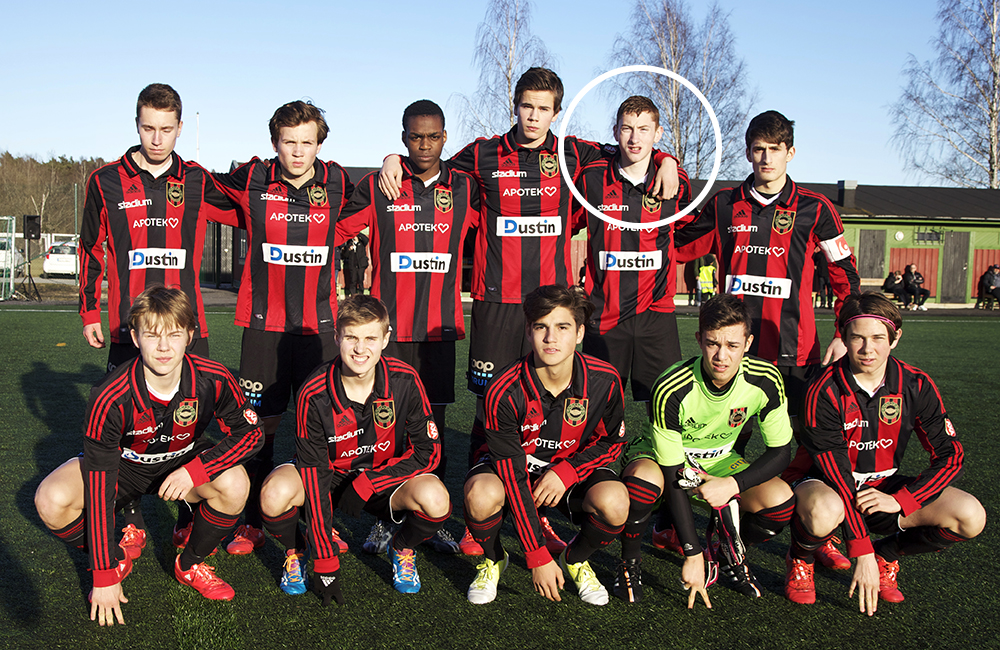
In the picture: Dejan Kulusevski (circled) back in his playing days at IF Brommapojkarna (found here)
Foundation Phase: George Lappas

This needs time, should be individualised and shouldn’t be rushed.

This unnamed player is now a full international.

But his development at an early age did not always follow a smooth path.

According to one of his ex-coaches at foundation phase level, he once behaved so badly had the situation not been resolved in a correct manner, he would not have been able to play for his team again.

Aged 11, the player is said to have reacted very strongly and negatively to an occurrence during a game.

He was extremely upset providing his coaches with a huge challenge: how to help the player review the situation, show a positive response and learn his lesson.

PROJECT

“We chose to give him a three-week break from matches, but he continued training”, one of the coaches, George Lappas, told Breakthrough.

“We allowed him to come to watch the matches and support his teammates if he chose to, which he did.

“We also set him a project.

“In the first week, we asked him to go away and bring back a piece of work of his choice – picture, written, verbal, whatever he was comfortable with – describing the attributes of the ‘perfect’ player. He drew a picture and explained to us all the labels and diagrams.

“We spoke about his work and, and for the second week of his homework, asked him to go away and further develop the attributes of his ‘perfect’ player adding in extra detail.

“For his final week of homework, we asked him to rank himself against the attributes of the ‘perfect’ player with a score out of 10. For example, if the perfect player had a perfect score of 10 out of 10 for ‘Focus’, he would then give himself a score out of 10 for the same attribute. He did this for all the attributes.”

The plan worked wonders.

Once he returned from his enforced ‘break’, he was a completely different player.

“What this exercise showed him was where his strengths and weaknesses lay and where he needed to do most of his improvement”, Lappas explained.

“We discussed the scores he gave himself and spoke about them in detail. We explained how his ‘weakest’ areas held him back and what it would cost him if he persisted with those behaviours.

“We asked him to describe what he would feel like if he was able to turn those ‘weak’ areas of his game into genuine strengths. We put a plan in place to improve those ‘weak’ areas and reviewed them regularly.”

TECHNICAL TOOLS

George Lappas, who currently works as opposition analyst and first-team scout at Millwall, has spent 20 years of his career coaching at all levels of the foundation phase of player development.

“The priority is on the players’ technical development at this stage”, he believes.

“This is to provide the players with the tools they will require to undertake more complex tasks in the next phase.

At the younger ages this would be with players working on individual skills.

At the later stages of this phase you would be looking at combinations and overloads in pairs and maybe 3-4 players.

“Technicality, however, isn’t learned in isolation, and within the foundation stage the areas of tactical, physical and psychological must also develop. 

“The individual action is the most important, taking guts and encouragement, but should be guided to become efficient for the team.”

ACCELERATED LEARNING

However – and similar to Roy Thomas – Lappas also highlights another aspect of player development.

“One area I think that is often omitted, or at least underappreciated, is the importance of developing the mindset necessary to improve most effectively.

“The process of review is passed over all too quickly.

“Communication, and appreciation of the meaning of successes and failures, are vital. What went well. What didn’t go well. What needs to change.

“This needs time, should be individualised and shouldn’t be rushed.

“This is accelerated learning. In a way it is slower, but actually learning takes place faster overall as it is deeper and self-guided.”

The project the now international player undertook at the tender age of 11 is perhaps the ‘perfect’ example of an attempt at developing the required mindset.

It took time.

It was individualised.

It was not rushed.

It also got deeper and was certainly self-guided.

Finally, and above all, it proved successful, too. Short- and long-term.

George shares his knowledge via his ‘Golden Game Soccer’ project. You can join it here

How It All Began: Ferran Torres

If these boys do not reach the elite in five years, I would have to change profession.

They could be born anywhere.

In a big city or in a small village.

Sometimes they come out of nowhere.

Other times you always seem to know they will eventually make it. And usually sooner rather than later.

On occasions, they grew up as local stars – always so much better than their peers.

It would also occur that their talent was very highly thought of from their early days, but so was the one of some other players in the same age group.

BIG PITCH

Ferran Torres was born in a small town of Foyos, around 10 kilometres north of the big city of Valencia.

He was to become no local star.

By the tender age of just six, he already trained at Valencia Club de Fútbol – Champions League finalists not once but twice just a few years earlier.

Little Ferran had been recommended to the club by his physical education teacher after first kicking the ball at school, on a futsal pitch.

At Valencia, they had a closer look. And clearly liked what they saw.

Quick, talented, bit cheeky and above all, a goalscorer“, is how one of Torres’ first coaches, Raúl Muñoz, remembers the now 20-year-old.

However and perhaps surprisingly, it was not until playing at a full-sized pitch when Ferran really started to shine.

Earlier, in what was then seven- rather than the now more common in Spain eight-a-side football, he was good, but did not particularly stand out.

Humble and introverted“, are other words that tended to describe him.

Ferran Torres scored both goals in last summer’s UEFA European Under-19 Championship final against Portugal, adding to his gold medal in the same tournament at the under-17 level.

ROUGH DIAMOND

“If these boys do not reach the elite in five years, I would have to change profession”, another now ex-coach at the Valencia Academy, Javier Jordá, recently said.

Torres was not the only super talent in his age group.

In fact, Valencia have recently had a rather impressive record as far as proper academy products are concerned.

Carlos Soler (born in 1997), who was born in the city, has been at the club since the age of eight.

Defender Hugo Guillamón – a month older than Torres with whom he won both the under-17 and under-19 European Championship title – moved to Valencia from San Sebastián aged two and joined VCF six years later.

Lee Kang-in (born in 2001) then travelled the world at the age of 10.

And it was the South Korean and Torres who Jordá was referring to.

There were other players who have since not made it but who also contributed to this particular age group, born in 2000, having been regarded as a glorious generation at the club.

Torres is just the rough diamond that eventually shone through.

In the picture: Ferran Torres as a kid (found here)

My Research: So Far (Part 5)

Since the start of 2020, I have been monitoring the progress of young players in Europe’s top five leagues. The coronavirus pandemic has provided an opportunity to sum up some of the very first findings.

Part 1: The Most Influential Under-23s

Part 2: The Most Influential Teenagers

Part 3: Nationalities of Most Influential Under-23s

Part 4: Nationalities of Most Influential Teenagers

In part five, I have looked at positions on the pitch of the most influential teenagers, i.e. under-20 players (born in 2000 or later) who appear in games, i.e. start or come on as substitutes*.

Positions have been divided into the following categories: [1] goalkeepers; [2] centre backs; [3] full-backs; [4] central midfielders; [5] attacking midfielders; [6] wingers; [7] forwards.

As for players appearing in more than one position on the pitch, their main position has been established.

(For example: if a player’s main position is a forward but he is used as a winger, he has still been classified as a forward. Alphonso Davies has thus been put into the winger rather than full-back bracket.)

Let’s look at starts, first.

The cumulative number of under-20 starters per position on the pitch across Europe’s top five leagues so far in 2020.

Forwards are leading the way with 23 players aged 20 or under playing in this position on the pitch having started at least one game in one of Europe’s top five league competitions since the start of this calendar year.

Central midfielders come second, although it is worth pointing out that nearly half of them (8 out of 18) have started matches in Ligue 1.

Centre backs (but again, 7 out of 12 coming from the French top division) and wingers find themselves joint third.

There are also seven full-backs, six attacking midfielders and no goalkeepers at all.

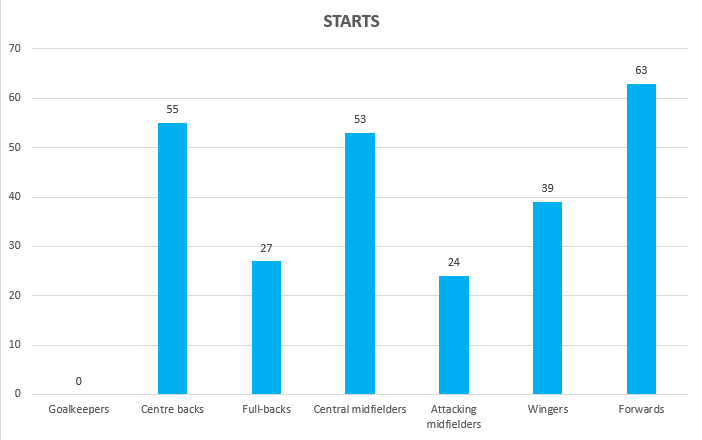
The cumulative number of starts made by under-20 players per position on the pitch across Europe’s top five leagues so far in 2020.

When it comes to the total number of starts made by under-20 players across Europe’s top five leagues so far in 2020, forwards are also top with 63 outings from the first minute of a game.

Centre backs – with 35 out of 55 starts having come in Ligue 1, none in La Liga and solely one in the Premier League – have edged central midfielders – with 29 out of their 57 starts having been registered in Ligue 1 and just two in La Liga – into second place.

Wingers are fourth on 39 starts (none in Serie A), ahead of full-backs (on 27, with 75% of them having come in the Premier League) and attacking midfielders (with 11 out of 24 starts stemming from La Liga players).

Let’s move onto appearances.

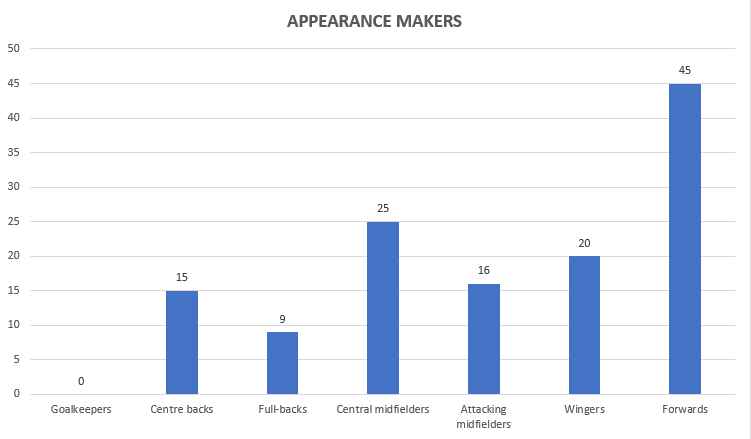
The cumulative number of under-20 appearance makers per position on the pitch across Europe’s top five leagues so far in 2020.

As far as under-20 players who appear in matches, i.e. start and/or come on as substitutes, across Europe’s top five league competitions this calendar year are concerned, forwards are still in pole position.

As many as 45 different forwards have made at least one appearance.

Central midfielders sit second (on 25), ahead of wingers (20), attacking midfielders (16), centre backs (15), full-backs (9) and, one more time, goalkeepers (0).

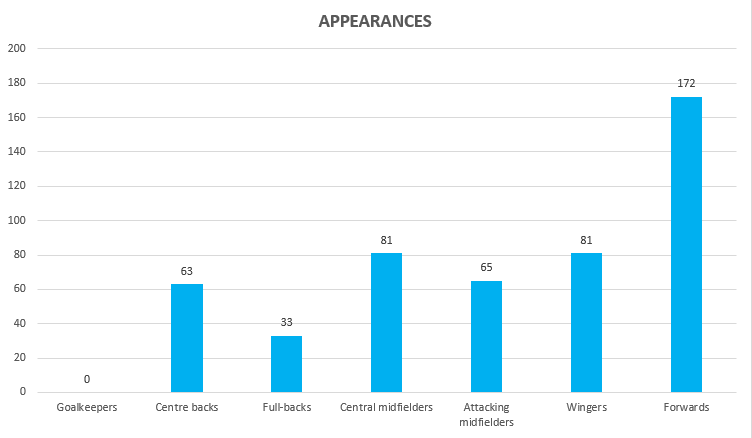
The cumulative number of appearances made by under-20 players per position on the pitch across Europe’s top five leagues so far in 2020.

Once starts and substitute appearances are put together, attack prevails.

Forwards have made a total of 172 appearances in Europe’s top five leagues so far in 2020.

Central midfielders and wingers have produced 81 each while attacking midfielders have appeared on the pitch on 65 occasions, with centre backs on 63.

Full-backs have only made 33 appearances.

* all data concerns the period from 1 January to 28 May 2020

In the picture: Ahmed Kutucu has made nine substitute appearances for Schalke already this year, although he has not yet started a Bundesliga game in 2020 (found here)

Design a site like this with WordPress.com
Get started