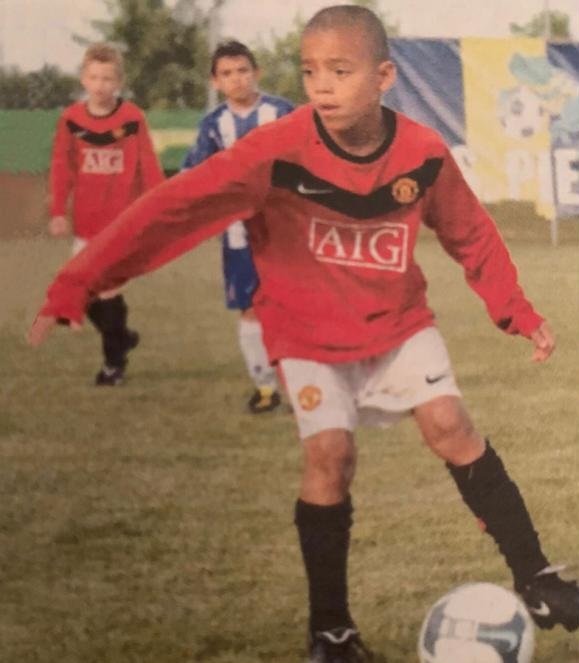
How It All Began: Ansu Fati

No one was able to take the ball off him.

Bori Fati must have been surprised, if not worried.

When returning home from work, like every day, he encountered a group of neighbours and young boys waiting for him on the doorstep.

“Do you know what you’ve got here?”, he was asked. “You need to see it. This kid needs to play at a club.”

The kid has not stopped since, his dad himself has admitted.

DECADE OF GRAFT

Everyone has their own unique story. The one belonging to Bori Fati appears simply exceptional, though.

The Bissau-Guinean was a semi-professional footballer in his homeland until his wife, María, got pregnant with the couple’s first son.

The father quickly made a life-changing decision. He opted to travel the world in the search of a better future for his family.

He first spent four years working in Portugal before heading to Andalusia, where he helped with the construction of the railway line between Córdoba and Málaga. It was then when he moved in to the village of Herrera. He still lives there today.

Upon completion of the railway works, Fati senior reportedly offered his services for a variety of job roles: from a bricklayer, through a waiter, to a dustman.

He was a likeable character. As a result, he received help. Including from Juan Manuel Sánchez Gordillo – the mayor of Marinaleda, another village just west of Herrera. Bori became the politician’s chauffeur.

It was only then, a decade after first setting foot on European soil, when he could finally afford to bring his family over from Africa.

His second son, Anssumane, was six at the time.

TIME CONSTRAINTS

Despite his footballing past, the father was simply too busy to even know about Ansu’s own love for the game.

“I did not even know he had played [football] in Guinea”, he revealed. “I presumed he had kicked the ball around in the street, but nothing more.

He told me he wanted to play and [asked me] to take him to the pitch, but when I managed to bring the family [to Spain], I had a lot of things to do and I did not have the time.”

Young Ansu – along with his 11-year-old brother Braima – had to take the matter into his own hands.

BAREFOOT

It was at the end of the summer, back in 2009.

According to Joaquín Sánchez, the six-year-old, who first turned up to a training session in his new home, was quite tall for his age and very slim.

He was also barefoot and wore swimming trunks. Not that it bothered him.

“He was spectacular, we were left astonished”, remembered the local club’s head of coaching. “We did not know where he had come from, but it was clear he could play: no one was able to take the ball off him.”

Sánchez was even more amazed when Ansu answered his following two questions.

“Who are you with?”

“Where do you live?”

PASSION

Of course, young Fati – who also has one younger brother and two sisters – did not stay long in Herrera.

He was soon spotted at a tournament by Pablo Blanco, head of academy at Sevilla, who brought him to the club.

A year later, both Albert Puig of Barcelona and Paco de Gracia of Real Madrid paid visits to the family.

“Madrid offered me better conditions in terms of money, a house, everything”, Bori Fati recalled. “But I chose Barça because Valdebebas [Real Madrid’s training ground] did not have a hall of residence at the time and I did not want the young boy to get lost [in the city].”

As remarkable as it sounds, the just nine-year-old Ansu was on the move again. This time he was to live among strangers, at the famous La Masía, although his older brother was taken up by Barcelona, too. Initially, his mother also managed to spent several months in the city.

“It was very difficult for him”, Jordi Figueroa, Fati’s coach in Herrera, remembered. “If Ansu is where he is now it is because, above all, he likes football. He has an incredible passion [to the game].”

Bori Fati can probably still scarcely believe his luck.

In the picture: young Ansu Fati could have joined Real Madrid had the club had a hall of residence at their training ground at the time. Last week, as a Barcelona player, he scored his first goal for Spain at Valdebebas (found here)

Foundation Phase: Crewe Alexandra

This is an abstract from my own blog post which was originally written in Polish on 28 January 2018. I both translated and updated it on 16 August 2020.

There is no such thing as being marked. Your job is to get away from your marker.

Garratt; Mellor, Davis, Ray, Tootle; Colclough, Turton, Murphy, Moore; Clayton, Leitch-Smith.

Do you know any of the names above?

Ben Garratt; Kelvin Mellor, Harry Davis, George Ray, Matt Tootle; Ryan Colclough, Oliver Turton, Luke Murphy, Byron Moore; Max Clayton, AJ Leitch-Smith.

How about now?

On 27 April 2013, on the last day of the English League One season, these 11 players entered world football’s history books.

It was probably the first-ever documented case of a starting line-up of any club, in any country and in any game to be made up solely out of the same club academy’s youth products.

Crewe Alexandra made it to the backpages of British newspapers.

(And they then repeated the feat on the last day of the 2017/18 League Two season.)

“Some thought it was a publicity stunt”, remembered Aidan Callan, the Crew Alex Academy operations manager who spoke at the Football Academy convention back in January 2018. “But we beat Walsall who were competing for a play-off spot.”

This is not the end of this story, though.

Five seasons later every single one of those 11 players still played professional football. Two were still at Crewe. Five were playing in the same division (League One). One was playing a league above (Championship), one each were playing in the Scottish Premiership and in the Scottish Championship. Two were playing in the same division that Crewe were at the time (League Two).

Take a look again.

Garratt (Crewe); Mellor (Blackpool), Davis (St Mirren), Ray (Crewe), Tootle (Notts County); Colclough (Wigan Athletic), Turton (Blackpool), Murphy (Leeds United/Burton Albion), Moore (Bristol Rovers); Clayton (Blackpool), Leitch-Smith (Shrewsbury Town/Dundee).

To provide some context, as Michał Zachodny presented at the same event, only 46% of 19-year-olds who appeared in one of Europe’s top five leagues at the time, still played at the same level three years later.

But that’s still not everything.

As Callan showed, one of those 11 players was at Crewe from the under-6 age group. Another four joined as under-7s. Two were under-8s. One each were under-9 and under-10. Just one each were under-15 and under-16.

My Research: The English Route

TURN OR SHIELD

How is it possible that a club from a town located in the historical, post-industrial part of England that in the past produced players such as David Platt, Neil Lennon, Robbie Savage, Danny Murphy and Dean Ashton keeps bringing professional footballers through the ranks despite having never played in the top-flight of English football?

“We will show you a couple of simple things, but also some that in our view are specific to our academy”, said Lee Bell, the current Crew Alex under-18 coach who led a taster training session at the FA convention back in January 2018.

What was the specific aspect?

Above all, it was the focus on individual player development at all stages. From the under-6 age group right up to the under-18s.

During the session Bell kept his word by showing simple and well-known exercises. He paid attention, however, to essential details such as working on both sides of the body, shielding and turning with the ball.

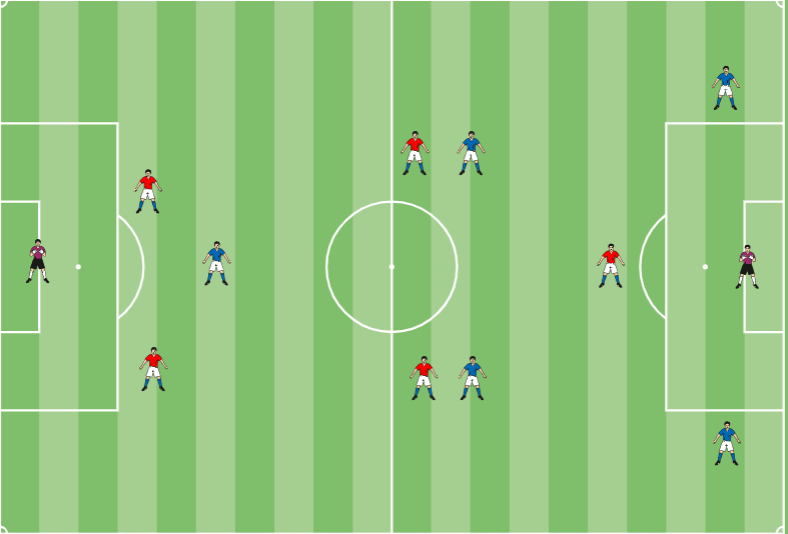
In the main part of the session the pitch was divided into three parts, as you can see below.

The focus of the task game was put on the midfielders in the 1-v-1 situations. Their job – upon receiving the ball from the defenders – was to transfer it as quickly as possible to the striker: by immediately turning with the ball or – if that was not possible – by shielding it and getting away from their direct opponent. They were not allowed to pass the ball back to either of the defenders.

“There is no such thing as being marked”, Bell insited. “Your job is to get away from your marker.

“We, as a small club, need to put more effort into player development.”

In the picture: Crewe Alexandra first put out a starting line-up formed by club academy youth products only on the last day of the 2012/13 season (found on the club’s Facebook page)

How It All Began: Mason Greenwood

It was like a 13-year-old hitting it.

There would still be around 20 minutes until the start of the training session.

Yet, one young boy would already be honing his skills.

He would be hitting the ball at a bin outside the door. With both feet.

It would only be his warm-up.

“We used to do little shooting games in which you would try to create a little bit of space and get a shot off but we’d go in net because we didn’t have goalkeepers in the development centres”, Mark Senior remembers. “Me and the other coach Gabriel would go in net and you could feel it when Mason hit it.

“Most kids at seven years of age, you would let it in to give them a bit of confidence. But Mason would smash it in the bottom corner and if he did hit it at you you’d know about it. It was like a 13-year-old hitting it.”

Mason Greenwood was born in Bradford – depending on traffic, about an hour away from Old Trafford. He first started playing organised football closer to home, though. Aged six, he joined one of Manchester United’s 46 development centres in Halifax. A 15-minute drive.

Soon, he would be travelling additionally to Salford every Sunday to play small-sided games with and against his peers from other club development centres.

Senior, an ex-coach at both the United Academy and the Halifax development centre, spoke about young Greenwood in great detail upon the now-teenager’s first-team debut last year.

QUICK LEARNER

“When Mason Greenwood came in at six, he could use both feet equally as strong”, Senior told the Manchester Evening News. “He was absolutely rapid. As soon as you showed him a little trick or anything he would just do it straight away.

“We started really advancing him and as soon as you’d show him a new move or skill, within 30 seconds to a minute he’d be doing it already.”

ATHLETE

“I’ve not seen another player like him. His style means his pace is deceptive because he is absolutely rapid.

“I think he turned up at a Great Britain under-13 100m sprint race and broke the Great Britain record. All the athletics people were after him at one point. Athletically he’s unbelievable.”

ENVIRONMENT

“When they came it was about just letting them play and trying tricks, trying dribbles. Whereas most clubs would go the opposite way by thinking football as a team sport requires that players are drilled into passing and playing in a specific position. At United it was the polar opposite and obviously it worked.

“You’re teaching the kids to be greedy, really, but in a nice way. It was about not letting them be scared of losing games or losing the ball. Straight from the word go, if they made a mistake no-one corrected them.”

ATTITUDE

“Mason always conducted himself very well but also had not an arrogance but a confidence about him. You need it. You could always tell with Mason that he would get to where he wanted to go.

We never did man-of-the-match awards because you lose all intrinsic motivation from it. Does Mason have the right sort of attitude? He will have because he never had that trophy for just playing on a Sunday morning. They didn’t need it, all they needed was to play the game.”

COACHING

“We’re chuffed to bits that he’s doing what he’s doing but I don’t think it’s down to the coaching necessarily. He was going to be a player. If we’ve given him 0.5% help then that’s fine.

“The guys that used to work there eight or nine years ago keep in touch and we all sent each other a text message about that, saying ‘the first one’s come through’. But we always knew that he would. We said if he doesn’t make it then we probably need to pack it all in. He was always the obvious candidate.”

Top bins.

In the picture: Mason Greenwood has been affiliated to Manchester United since the age of six (found here)

My Research: The ‘Unconventional’ Route

Since the start of 2020, I have been researching career pathways of current under-23 players across Europe’s top five leagues. As a result, I have so far distinguished five different routes into professional football. This post is dedicated to the fifth and – at least for now – last of them, which I called the unconventional routeIt is about players who broke through into senior football having been released by another club at an earlier stage or those whose development pathway took an unusual shape.

Route number 1. You join a professional club academy no later than at the age of nine and progress all the way through into the same club’s first-team. This is the English route.

Route number 2. You join a professional club academy no earlier than at the age of 10 having spent several years at a local club(s). This is the French route.

Route number 3. You join a foreign club without having made a senior debut in your home country. This is the international route.

Route number 4. You start your senior career in non-league, amateur or semi-professional football. This is the amateur route.

Route number 5. You break through into senior football in any other way than any of the four listed above. This is the unconventional route.

CIRCUMSTANCES

“They just said they had other players here at the time who were ahead of me”, remembers Dwight McNeil who moved to Burnley having been released by his boyhood club Manchester United at the age of 14.

“I got told I wasn’t the best at crossing at the time.”

McNeil was not the only one, of course.

The likes of West Ham United’s Declan Rice and Arsenal’s Eddie Nketiah were released by Chelsea aged 14 and 16 respectively.

Meanwhile, Southampton’s Michael Obafemi even took a year out of the game after being told he was leaving Watford as a teenager.

Perhaps naturally, not every young footballer could be deemed good enough by a top club academy.

The competition is fierce. Sometimes a player may not yet be ready to handle the pressure or simply does not fit well enough into the environment he has found himself in. He may, though, flourish elsewhere. Other times, he decides for a move to another top club, domestic academy.

This is what, for example, Rhian Brewster did when swapping Chelsea for Liverpool at the age of 14.

There could be personal circumstances, too. Sampdoria’s Ronaldo Vieira was a 13-year-old Benfica Academy youth player when his family opted for a move to England to search for more job opportunities. Via several local clubs, he joined Leeds United four years later.

OBSTACLES

My research could yet see more different routes into senior football becoming established.

For now, the unconventional route could be regarded as one that provided young players with unexpected obstacles.

For more of my findings next season follow me on Twitter.

In the picture: Dwight McNeil, who was released by Manchester United at the age of 14, started every Premier League game last season (photo courtesy of Burnley FC)

Design a site like this with WordPress.com
Get started