Since the start of 2020, I have been researching career pathways of current under-23 players across Europe’s top five leagues. As a result, I have so far distinguished five different routes into professional football. This post is dedicated to the second of them, which I called the French route. It is about players who joined a professional club academy aged 10 or older having earlier played at a local grassroots football club(s).
My research project – and this blog – began with the ‘English’ route.
Initially, I only looked out for players who joined a professional club academy at a very young age and then progressed all the way through to the same club’s first-team.
However, there always seem to be various pathways leading to the same goal.
And perhaps the most common route to becoming a senior footballer is by starting out at a local grassroots football club and only moving to a professional club academy several years later.
Just as the likes of Eduardo Camavinga and Kai Havertz have done.
AS LATE…
In England, professional club academies are legally allowed to tie players to their first contracts from the third weekend of May at the under-8 age group.
They tend to compete for talent even earlier, though, with the idea that unless you attract a player as young as possible, someone else will do exactly that.
“We make them sign at a younger age now”, confirms Matthieu Bideau, head of recruitment at the FC Nantes Academy, just the other side of the English Channel.
“There is so much competition that if we don’t make them sign, someone else will take them.
“The local clubs are at war with one another to get the best players as young as possible. The English clubs are sharks. The French teams are sheep. The amateur clubs are sardines.”
What Bideau means by younger age, however, is 11-12. This is the earliest stage at which player scouting is said to begin in France.
As well as, for example, in País Vasco.
“We start late as we want them to have the chance to be kids first“, the Real Sociedad Academy director Luki Iriarte has recently explained.
“Down in Madrid and Valencia, and most of the continent these days, there are tournaments for under-7s. We don’t believe in that. By bringing players in later, we stand less chance of getting it wrong.
“Of course, there are kids who look good when very young and have the profile to win us youth tournaments, but do they have the profile of a player who will play in our first team?
“I’m convinced in our methodology a little bit more every single day.”
The youngest age group at the Real Sociedad Academy is currently the under-13s. They claim not to scout players younger than 10 years of age.
Instead, they have over 70 partner clubs in their region. Their neighbours Athletic Bilbao have over 100 of them.
“Yes, we run the risk that neighbouring clubs will pick them up during the younger years, but our message to them is: ‘Stay in your environment. Stay with your family. Stay with your friends‘”, Iriarte added.
“‘And if you feel like you’re ready to leave all of those behind, then you can come to Real Sociedad’.”
Sounds familiar?
There was a similar reasoning behind Bayern Munich’s recent, headline-making decision to scrap their under-9 and under-10 club academy squads.
Rather than running those age groups themselves, the German record champions have decided to develop their network of satellite clubs and increase opportunities for local talent to be able to showcase their skills and abilities in their natural environment for as long as possible.
… AS POSSIBLE
Could such an approach work in, say, London? Or in any other city where there is no one dominant club?
Possibly not.
The likes of Athletic Bilbao and Real Sociedad, separated from each other by around 100 kilometres, have used it to their advantage, though.
Just take a look at the former’s current first-team squad.
All nine of their under-23 players started their careers at local clubs and only joined Athletic aged 10 (Unai Núñez), 12 (Iñigo Córdoba), 14 (Unai Simón and Asier Villalibre) or even 16 (Bilbao-born Unai Vencedor).
As for their local rivals, the story is much the same.
Igor Zubeldia and Ander Barrenetxea were both 11 when they joined the club. Martín Zubimendi was 12.
More examples can be found in other countries.
Kylian Mbappé was as old as 14 when he left the suburbs of Paris for Monaco. Suat Serdar was 11 when he signed for Mainz. Alex Meret was 15 when he first trained with Udinese. And even Ben Chilwell did not join Leicester City until he was 13.
THE FRENCH ROUTE
In contrast to the English route, the French one seems naturally much more common, although not exclusive to, among players who were born and raised in small towns rather than big cities.
After all, not every child happens to grow up near a professional club academy.
And a lot of them, if not most, actually do come from towns and villages rather than metropolis.
Don’t they?
VISIT THIS BLOG NEXT WEEK TO LEARN ABOUT THE INTERNATIONAL ROUTE.
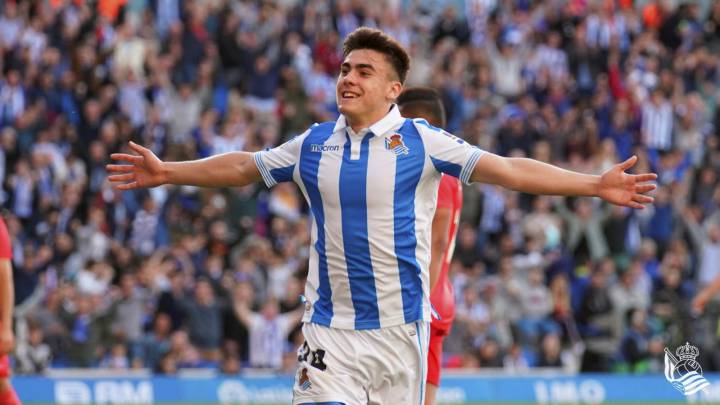
In the picture: San Sebastián-born Ander Barrenetxea, who joined the city’s La Liga club aged 11 from a local team, is the second youngest-ever player to appear for ‘La Real”s first-team (found here)
 BREAKTHROUGH