Since the start of 2020, I have been monitoring the progress of young players in Europe’s top five leagues. The coronavirus pandemic has provided an opportunity to sum up some of the very first findings.
I have also been keeping tabs on teenagers, i.e. under-20 players (born in 2000 or later), who appear in games, i.e. start or come on as substitutes.
So far in 2020, a total of 124 different players aged 20 or under have made a cumulative number of 452 appearances in Europe’s top five leagues.
Let’s look at starts, first.
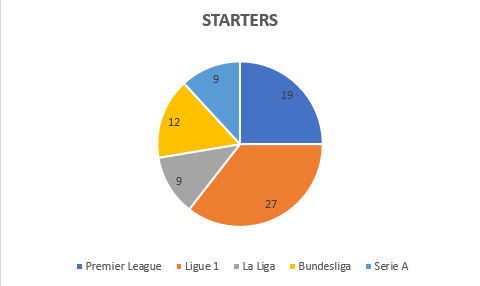
As you can see below, the highest number of under-20 starters, i.e. players who have started at least one league match so far in 2020, can be found in Ligue 1.
The number of under-20 starters per league so far in 2020.
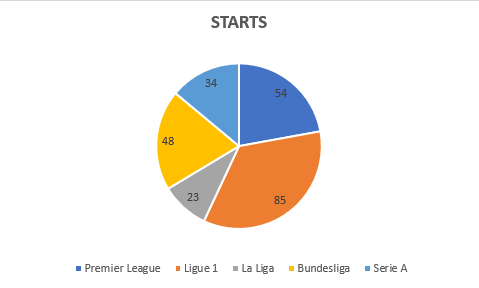
The Ligue 1 teenagers have already made 85 starts this year – in comparison to just 23 starts made by their La Liga peers.
The number of starts made by under-20 players per league so far in 2020.
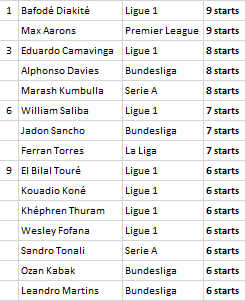
Bafodé Diakité, Max Aarons and Alphonso Davies are the only teenagers in Europe’s top five leagues to have started every single league game their clubs have played so far in 2020.
The best under-20 starters in Europe’s top five leagues so far in 2020.
Let’s now take a look at all apps, i.e. starts and substitute appearances put together.
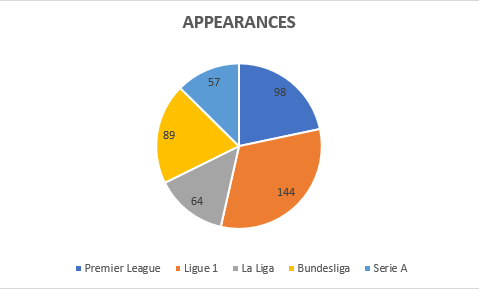
Here, Ligue 1 are top and – when it comes to the actual number of appearances – comfortably top again.
The number of under-20 appearance makers per league so far in 2020.The number of appearances made by under-20 players per league so far in 2020.
Takefusa Kubo, Dušan Vlahović, Giovanni Reyna, Erling Haaland and Jadon Sancho have also appeared in every single league match their clubs have played so far in 2020.
The best under-20 appearance makers in Europe’s top five leagues so far in 2020.
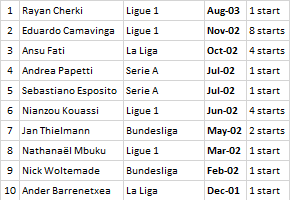
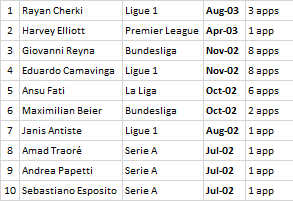
Who are then the youngest teenagers to have appeared on the pitch in Europe’s top five leagues so far in 2020?
In fact, the Premier League are the only competition out of the five in which a player born in 2002 or later has not yet started a match. Mason Greenwood – born in October 2001 – is the youngest one there, with two starts made.
The youngest teenagers to have started at least one game in Europe’s top five leagues so far in 2020.The youngest teenagers to have made at least one appearance in Europe’s top five leagues so far in 2020.
Finally, let’s look at the youngest teenagers who have influenced games, i.e. have scored or assisted at least one goal in Europe’s top five leagues so far in 2020.
Dejan Kulusevski – born in April 2000 – is the youngest player to have scored a goal in Serie A so far this year.
The youngest teenagers to have scored at least one goal in Europe’s top five leagues so far in 2020.The youngest teenagers to have assisted at least one goal in Europe’s top five leagues so far in 2020.
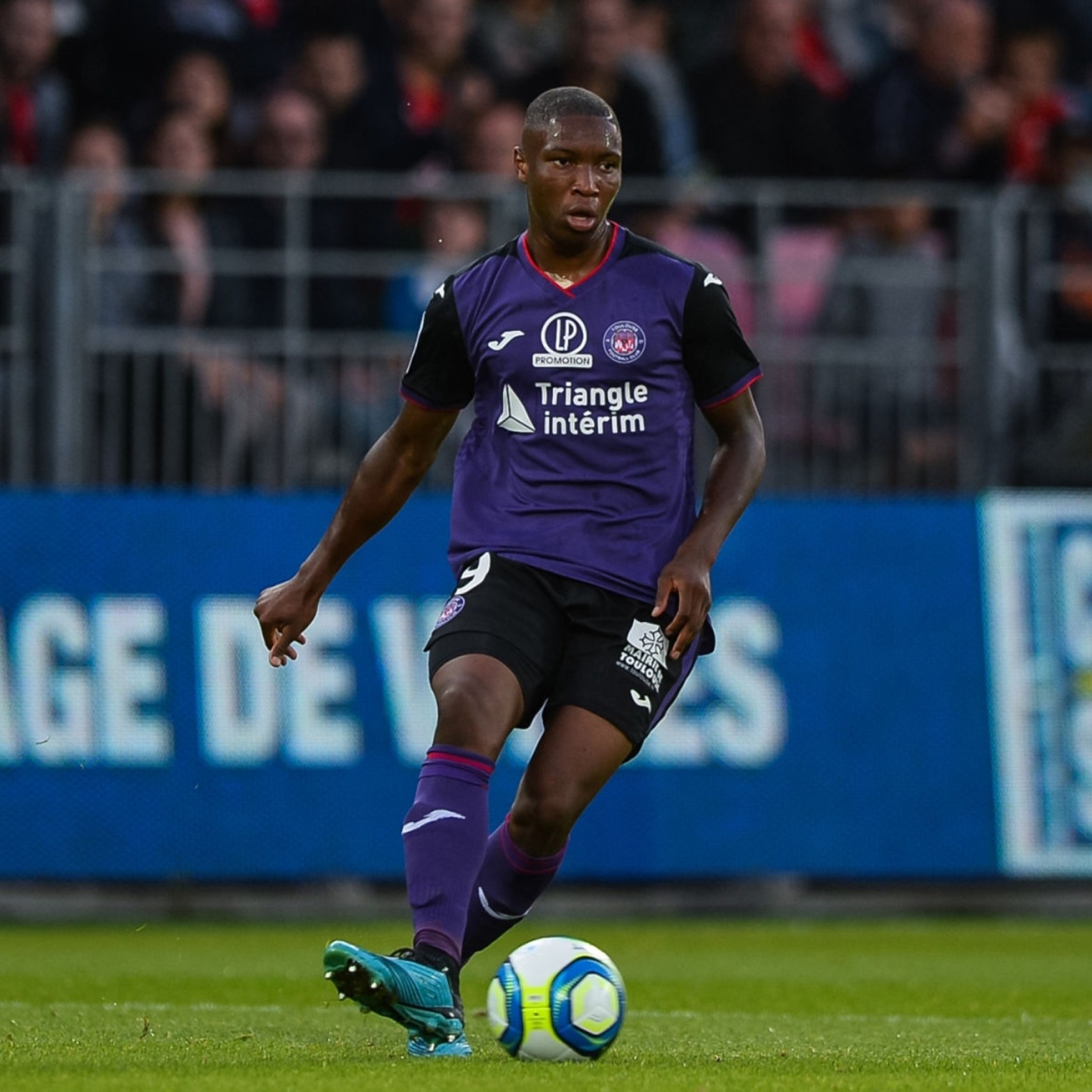
In the picture: Toulouse defender Bafodé Diakitéhas started every Ligue 1 match his club have played so far in 2020 (found here)
Since the start of 2020, I have been monitoring the progress of young players in Europe’s top five leagues. The coronavirus pandemic has provided an opportunity to sum up some of the very first findings.
First, I have been tracking under-23 players (born in 1997 or later) who directly influence the outcome of games, i.e. score and assist goals.
So far in 2020, a total of 176 different players aged 23 or under have scored and assisted a cumulative number of 371 goals in Europe’s top five leagues.
Let’s begin by looking at goalscorers.
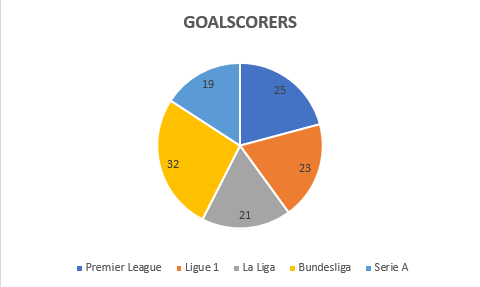
As you can see below, the highest number of under-23 goalscorers, i.e. players who have scored at least one league goal so far in 2020, can be found in the Bundesliga.
The number of under-23 goalscorers per league so far in 2020.
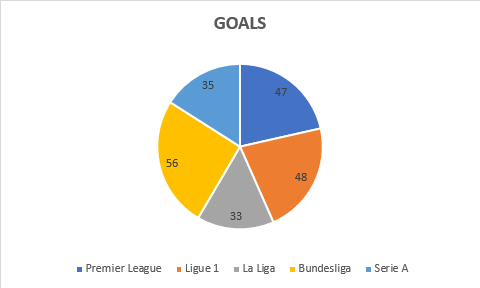
Those 32 Bundesliga goalscorers are also the most influential when it comes to the actual number of goals they have all scored, not far ahead of their Premier League and Ligue 1 peers, but significantly surpassing their La Liga and Serie A counterparts.
The number of goals scored by under-23 players per league so far in 2020.
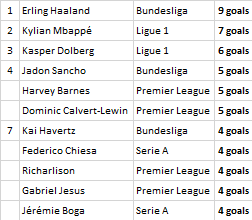
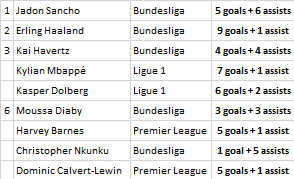
Erling Haaland currently sits top of the best under-23 goalscorers in Europe’s top five leagues in 2020, ahead of Kylian Mbappé and Kasper Dolberg.
The best under-23 goalscorers in Europe’s top five leagues so far in 2020.
Let’s now take a look at assist makers.
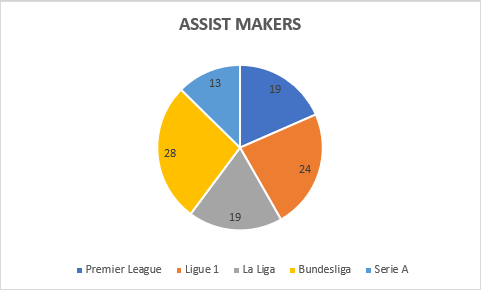
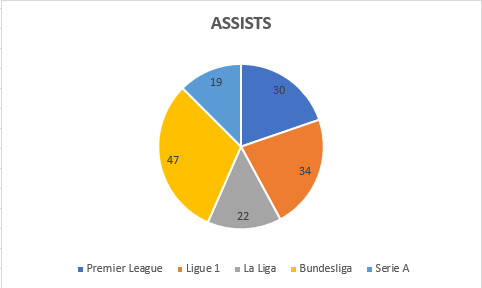
Here, the Bundesliga are top once more with Serie A again bottom.
The number of under-23 assist makers per league so far in 2020.
The 28 Bundesliga assist makers have also provided nearly three times as many assists as the 13 Serie A assist makers.
The number of assists made by under-23 players per league so far in 2020.
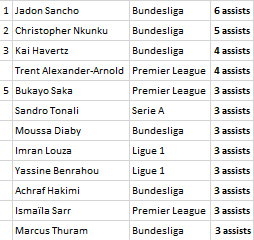
Jadon Sancho is currently the best of the best under-23 assist makers in Europe’s top five leagues in 2020, ahead of Christopher Nkunku, Kai Havertz and Trent Alexander-Arnold.
The best under-23 assist makers in Europe’s top five leagues so far in 2020.
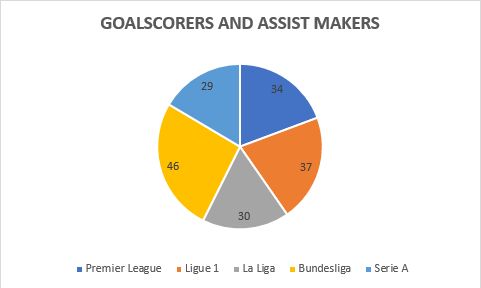
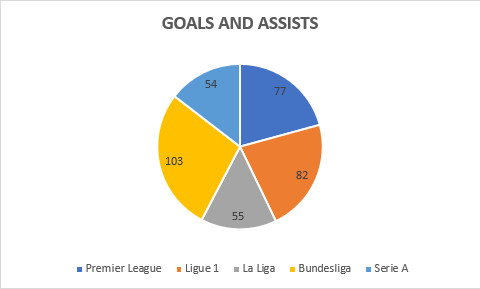
Finally, let’s see the two put together.
The number of different under-23 goalscorers and assist makers per league so far in 2020.The number of goals scored and assisted by under-23 players per league so far in 2020.The best under-23 goalscorers and assist makers (combined) in Europe’s top five leagues so far in 2020.
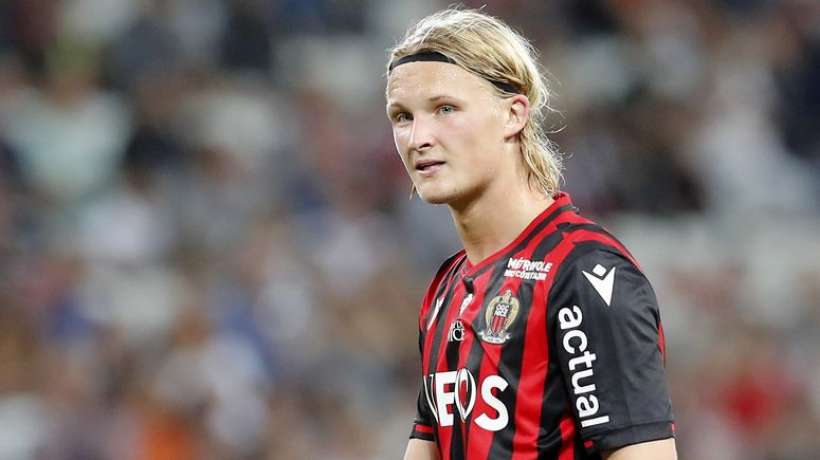
In the picture: OGC Nice striker Kasper Dolberg is the perhaps surprising name among the most influential under-23 players in Europe’s top five leagues so far in 2020 (found here)
This should come as no surprise. In the end, the population of the Île-de-France region (of over 12 million inhabitants) is indeed also bigger than the population of Belgium (of 11.4 million).
However, while Île-de-France makes up around 18% of the population of the country, its footballers, i.e. those born and/or raised in and around Paris, represent a significantly higher percentage of professional French football players.
The numbers are staggering.
And they seem to keep on rising.
According to economist Bastien Drut, back in the 1995/96 season only 10% of all French players to feature in Ligue 1 were born in the Île-de-France.
Eighteen years later, in the 2013/14 season, the figure grew to 27%.
This season (2019/20) every single Ligue 1 club has at least one player on their first-team squad who was born in the Paris region and then began his career at one of many local football clubs of the French capital. Only Metz and Montpellier do not feature one aged under-23.
What is more, last season (2018/19) as many as 158Franciliens featured in the big five European leagues, making up 6% of all players.
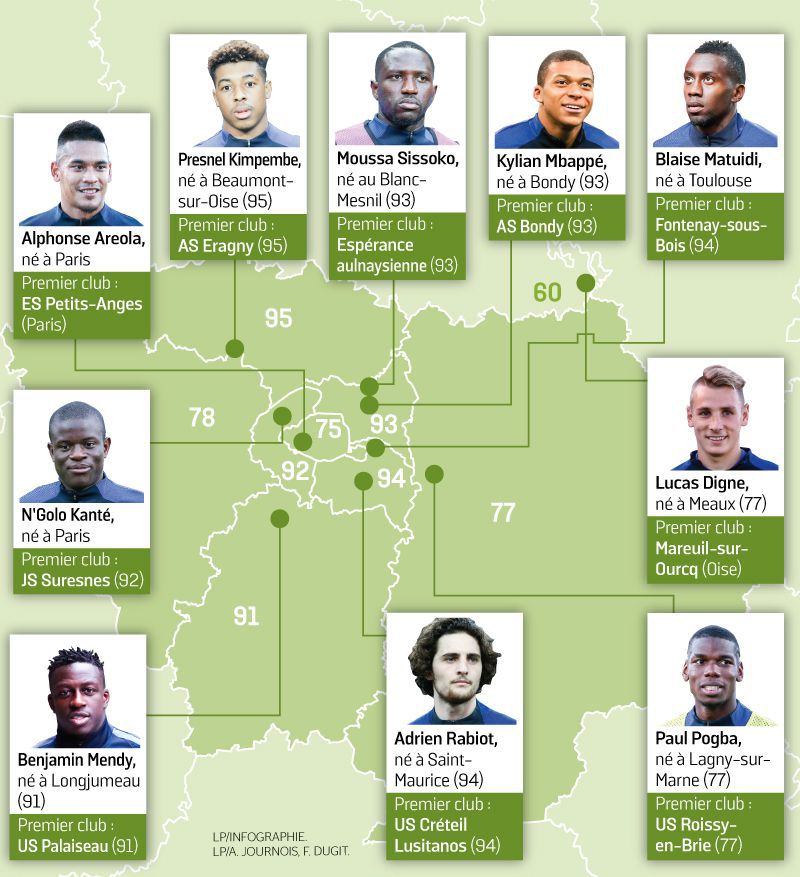
The France national team 2018 World Cup-winning squad featured eight Franciliens (35%), in comparison to just three (14%) back in 1998 and solely one (5%) for the 1984 European Championships triumph.
In the picture: just some senior French ‘internationals’ originating from Greater Paris (found here)
THE POWER OF THE SUBURBS
But what is it that makes the Île-de-France region – and its footballers – such a powerhouse of European football?
“The average level is higher in Île-de-France”, constitutes Jamel Sandjak, the chairman of regional league competitions.
“We have the best young players in the country confronting each other every weekend”, adds Coulibaly. “That is what makes the difference.”
There are other, perhaps somewhat obvious reasons, too.
“Youngsters are more motivated [here] to become professional footballers than elsewhere”, Sandjak points out.
“Because there is only football“, Paul Pogba told Simon Kuper a few years ago. “Whether it’s at school or outside in the neighbourhood, everyone will play football. And that helps people not to stay in the neighbourhood doing nothing and doing stupid things. Every day it’s the ball. That’s all there is.”
“But the real wealth of the Île-de-France region comes from children stemming from the African immigration“, says Bideau. “It is them who make up a significant part of the elite.”
Other factors may be less evident, though.
Kuper, who lives in Paris and claimed to spend lots of weekend mornings watching his children play football in the French capital, brings into focus the perhaps surprisingly high standard of sports infrastructure even in seemingly the poorest of suburbs.
Among old, dingy apartment blocks sit new-generation, state-funded artificial pitches. And neatly kept too, as Kuper points out.
“In Île-de-France, we have a lot of very good ‘educators’ as well as lots of synthetic pitches of the last generation”, adds Gilles Bibé, manager of AC Boulogne-Billancourt, one of the biggest clubs in the region.
And then there is potentially the biggest difference-maker nowadays.
Scouting.
Apparently, you will not encounter more football scouts anywhere else on the globe with the sole exception of São Paulo.
And not just domestic scouts either.
“We make them sign at a younger age now [from 11-12],” admits Nantes’ Bideau, situated nearly 400 kilometres west from Paris. “There is so much competition that if we don’t make them sign, someone else will take them.”
“The local clubs are at war with one another to get the best players as young as possible. TheEnglish clubs are sharks. The French teams are sheep. The amateur clubs are sardines.”
What do foreign scouts like most in French footballers?
“All the players who we recruited from France bring in a good mix of physical power, pace, explosiveness, but also good technical skills”, revealed the then RB Leipzig head coach, Ralf Rangnick. “They control the ball well because they learned to play and strike the ball in the street. We look for players who have that street football culture, with good technical skills and tactical education”.
“The winning team stays on the pitch”, describes Lionel Amegnizin, sporting adviser and expert on the Paris region. “So if you want to stay and play longer, you have to give everything you have.
“There is a difference of three, four, sometimes five years [between players]. The small one, when playing against somebody bigger and stronger, has to show his imagination and creativity to get out of the situation. Finally, in the suburbs, it is about your own identity, you have to establish yourself and win respect”.
THE BEDROCK
“There exists several places in the world that are the blessed lands of football: Brasil and France, and more particularly Seine-Saint-Denis”, these really are the words of nobody other than Bayern Munich’s Karl-Heinz Rummenigge.
If Île-de-France is the powerhouse of European football, Seine-Saint-Denis could be deemed its bedrock.
This département of Greater Paris, located north-east from the centre of the French capital, has not only – and not coincidentally – been associated with the Stade de France football stadium since 1997.
This is also where Thierry Tusseau (the only French 1984 European Champion from Paris) was born.
This is where nine of the 10 (90%) Île-de-France-born Ligue 1 players back from the 1995/96 season are originally from.
(And 19 from the 2013/14 campaign.)
This, finally, is where Kylian Mbappé was born…
… which brings us to Association Sportive de Bondy.
HONING AND DIRECTING
“We are lucky to have players who progress to professional academies every year”, says coach Antonio Riccardi.
And a lot of them.
In the video: in the footsteps of Kylian Mbappéin Bondy
Take not just Mbappé, but also his ex-teammate Jonathan Ikoné (now at Lille) as well as perhaps the next best thing in French football – defender William Saliba (currently on loan at Saint-Étienne from Arsenal whom he will join in the summer).
All three were born in the town of Bondy.
All three began playing football at the local football club.
All three spent at least six years at AS Bondy before moving to professional academies as teenagers.
Mbappé and Ikoné, who made his debut for the French senior national team last year, were both born in 1998 and were first coached – among others – by Kylian’s father, Wilfried.
Some sources claim that, as a child, Ikoné was an even better player than Mbappé. This was, at least in part, down to his dominant physique over his December-born teammate.
And one who loved to dribble and beat his opponents.
“I never told him to stop“, Riccardi said. “He was the best at that. Why would I have told him to stop? He was the best kid I coached. He is probably the best I will ever coach.”
Sébastien Corchia (currently on loan at Espanyol Barcelona from Sevilla) is another well-known former AS Bondy player.
The club – a big pond in Seine-Saint-Denis, which itself is, of course, a big pond in Greater Paris and Île-de-France – say there are about 30 players who, having trained at Bondy, have since turned into professionals.
It is difficult to pinpoint any potential secret of this seemingly typical local football club, based in the suburbs of one of the biggest metropolis on the globe.
Perhaps interestingly, Riccardi does not intend to make it easy for any of the current crop of potential stars of the future to come from Bondy.
One day, he made them train ‘on an uneven dirt field’ rather than ‘their’ artificial turf.
“This is where it is the hardest to play,” he explained. “So this is where they learn the most.”
The experienced coach also says players from the suburbs of Paris tend to ‘respond better to the stick than the carrot‘.
But above all, he ‘does not believe his job is to teach talent‘.
Much rather, it is about ‘honing‘ and ‘directing‘ it.
And, crucially, instill ‘values’ all these young people ‘will need whether they make it or not: “Punctuality. Manners. Fair play. Authority. Respect for the jersey.”’
In the end, this huge talent pond is always going to produce the next generation of professional footballers.
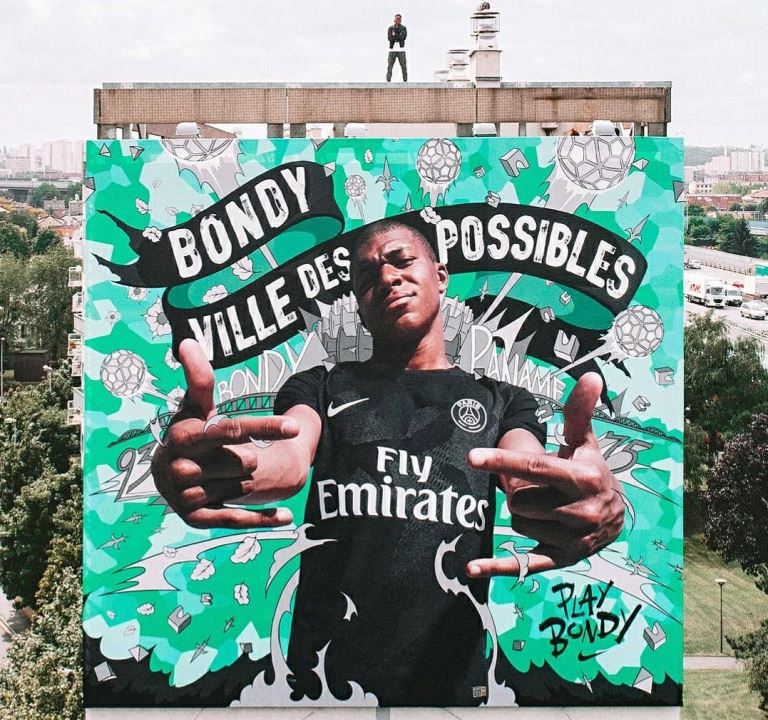
In the picture: Kylian Mbappégreeting newcomers arriving in Bondy, ‘the town of “what is possible”‘ (found here)
I prefer to watch a basketball game rather than a football match.
Careers of South American footballers tend to follow a seemingly similar pathway.
Step one: an early start playing football anywhere – in the street, on the beach, futsal.
Step two: joining a professional club academy in teenagehood.
Step three: a move to Europe, not long after breaking through into senior football back home.
The story of Inter Milan striker Lautaro Martínez is, on one hand, not much different. But, on the other, it is quite unique.
Football family
The Argentine signed for the Nerazzurri in 2018 from Racing Club de Avellaneda whom he had joined aged 16 from local club Liniers de Bahía Blanca, where he was born.
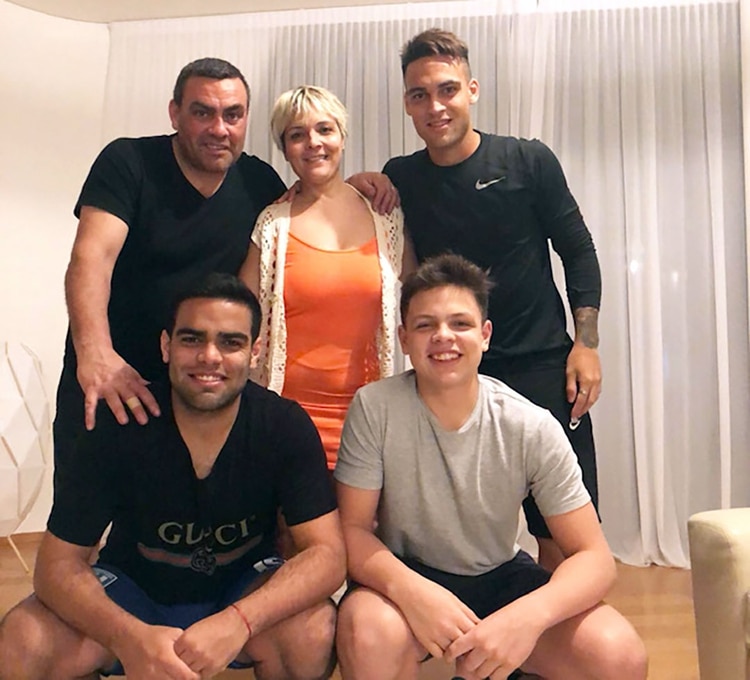
He has two brothers and, as usually the case with senior footballers, is not the oldest of the three.
However, Lautaro comes from a football family, which – perhaps contrary to common knowledge – relatively rarely transfers into a professional career in the game.
His father, Mario, played in the Argentinian second division for five seasons and in the third tier for another 13 campaigns. For different clubs, too, which meant the family was often on the move when Lautaro and his two brothers were children.
Today, all three are sportsmen. Alan (born in 1996) plays at centre-half for Liniers. Lautaro (born in August 1997) is an Argentina international. Meanwhile, Jano (born in 2003) has also already played for the national team and is currently the youngest player in the second division in Argentina.
But in basketball.
And it is the 16-year-old who last week revealed that his now famous older brother could have chosen a different sport, too.
“When we were all together in Bahía, we would always play a 2-v-2 on the court of Villa Mitre”, Jano said. “Me and my old man against Alan and Lautaro.”
“At one point, when 15, he nearly chose basketball when my old man asked him to go for one of the two sports… But of course, he was already very good at football back then.”
“I very much like basketball”, he had said. “I would play it as a child, but at 15 I had to chose and I went for football. However, if I were not a footballer, I would play basketball, I love it. What is more: I prefer to watch a basketball game rather than a football match.”
Lautaro also started out playing anywhere then. Just not only football.




 BREAKTHROUGH