How It All Began: Jamal Musiala

The ball stuck to his feet the whole time.

The best things happen by accident.

Or, perhaps, come from sheer determination.

“We phoned everybody around and did not get any further”, remembered Carolin Musiala.

“One day we simply went to the stadium then and learned about a holiday camp.

“Jamal joined in, scored a few goals and got spotted by scouts.”

It was autumn 2010 when Carolin Musiala seized an opportunity to spend a few months abroad and study sociology at the University of Southampton.

Looking back, it could be safely argued, however, that it was her then seven-year-old son who made the most of that time.

Jamal, whose father comes from Nigeria, had already been highly regarded at his local football club TSV Lehnerz, based in the city of Fulda in central Germany.

When he started, you could already see he was an exceptional talent“, his first coach, Branko Milenkovski, told the Osthessen-Zeitung back in 2011.

“He was ahead of his peers and always played a year above his age group.

“His strengths lie in his dribbling ability and pace. He would score four or five goals per game for us.”

At Southampton FC they were also impressed.

And not only them.

Young Jamal soon had three offers on the table. One from St Mary’s. The other two from Chelsea and Arsenal.

“We could not believe it at all”, recalled his mum whose education suddenly had to make way for his son’s own opportunities.

“We were simply overwhelmed. When Jamal found out, he even cried. For him, it was already a huge honour to be even invited.”

When the family, who had travelled to Southampton all together, returned to Fulda, only one decision could follow. In the spring of 2011 a life-changing move to London beckoned.

“We had to let it all go through our heads first”, Carolin admitted.

“We knew no rules nor conditions whatsoever. We had a careful look at the offers and then decided to which club Jamal would go.”

Chelsea were the destination.

He just stood out then, for his ball-dribbling skills and the ability he had“, recently remembered Graham Castle, the Chelsea scout who spotted young Musiala.

“The ball stuck to his feet the whole time.

“Obviously they [Southampton] liked him. But I sold it to him to come up and have a look at our facilities and our coaching. When he got there, our coaching was levels above other places. It all fitted into place.

“Because it was towards the end of that season, our under-8s were already established. He went straight into a friendly game with Blackburn Rovers. From that, they took him on. They could see his ability. He was going around players for fun.”

It was not all about Jamal’s ability, though.

“When he used to do our technical sessions on a Tuesday night, he was absolute tops”, Brian Mustill, who coached Musiala at the under-8 and under-10 age groups, told the BBC.

“He was at the top end of the potential range.

“When he lost the ball [however], he did everything in his power to win it back.

“I remember we played Spurs away, and I think he scored six or seven on the day. But it was his desire to win the ball having lost it, his energy levels to win the ball back.

“He chased the whole length of the pitch to win it back and then go and beat the whole team again.”

Jamal would never waste his time.

In the picture: Jamal Musiala began his football career at Fulda-based TSV Lehnerz aged five (found here)

Young Teams of 2020/21

All but six clubs in Europe’s top five leagues have featured at least one under-23 player – born in 1998 or later – at the start of the new season. I pick five young teams to watch this campaign.

Borussia Dortmund

Who else? It has been a stunning start to the season for BVB’s youngsters. Two 17-year-olds in debutant Jude Bellingham and Giovanni Reyna combined for Dortmund’s first goal of the new campaign against Borussia Mönchengladbach. Erling Haaland has already been on target four times this Bundesliga term, having been set up by Jadon Sancho (once) and Reyna (three times if you include a penalty won in the opening game) while also providing an assist himself for Felix Passlack in the dying moments of the most recent meeting with Freiburg. Next in line is Real Madrid loanee Reinier, who came on as a substitute in the last two league fixtures. Mainz and newly-promoted Stuttgart – with Congolese wing-back Silas Wamangituka having caught the eye in particular – may have featured even more under-23s than Dortmund at the beginning of the season, but it’s undoubtedly BVB who are the young team to watch this Bundesliga campaign.

Chelsea

You need to be really good to get a chance in the Premier League. Even more so as a young player. Fulham and Tottenham have not featured a single under-23 so far this season. Only one each has appeared for Burnley, Leicester and Newcastle. Six each have played for Leeds and Wolverhampton, but just three of them have been used in every match. As a result, it is indeed Chelsea who remain the young team to watch this Premier League campaign. The club proper youth products in Reece James, Mason Mount and Callum Hudson-Odoi have all already scored a goal each this season. Meanwhile, new signing Kai Havertz has provided his first assist while Christian Pulisic is also fit again. This may not be as young a Chelsea side as last term. But it is still the one to follow in the biggest league in the world.

Milan

Remarkably, no fewer than seven under-23s started Milan’s last game against Spezia. Gianluigi Donnarumma was in goal. Matteo Gabbia played at centre back. Sandro Tonali featured in midfield. The front four consisted of Rafael Leão, who scored twice in the second half, Brahim Díaz, Alexis Saelemaekers and 18-year-old Lorenzo Colombo who again deputised for the covid-infected Zlatan Ibrahimović. Furthermore, Jens Petter Hauge made his debut off the bench and the now 19-year-old Daniel Maldini also got a run-out late on in the game. Milan may be a shadow of some of the best sides in the club’s rich history, but they are the young team to watch this Serie A season.

Monaco

Both Monaco and Saint-Étienne have already featured a fairly staggering number of 13 under-23s at the start of the new campaign of the Ligue des talents. Despite 18-year-old Adil Aouchiche having started all six league fixtures for Les Verts, the eventual sale of 19-year-old centre back Wesley Fofana to Leicester means I have opted for Monaco as the young team to watch this Ligue 1 season. Left-footed France U21 centre half Benoît Badiashile is probably the pick of the bunch. However, it will also be particularly interesting to follow the progress of fit-again forwards Williem Geubbels and Pietro Pellegri – not so long ago regarded as the biggest teenage talents in France and Italy respectively. They’re both still just 19 years young.

Valencia

“I have been very pleased with your attitude since the first day, I do not think our squad is weak, I think it is young”, said new Valencia head coach Javi Gracia having eventually decided to continue in the job despite having not been allowed to make a single signing in this year’s summer transfer window. Where promises have been broken, the youth could flourish. Seventeen-year-old Yunus Musah has already made three La Liga starts this season – as did 19-year-old Lee Kang-in who also grabbed two assists on the opening day of the campaign against city rivals Levante. Since then, 20-year-old Hugo Guillamón has won himself a starting berth at centre back while fellow under-23s in Portuguese right-back Thierry Correia along with midfielders Vicente Esquerdo, Álex Blanco and Serbian Uroš Račić having also started at least one match each. Valencia are last season’s Chelsea. And the young team to watch this La Liga term.

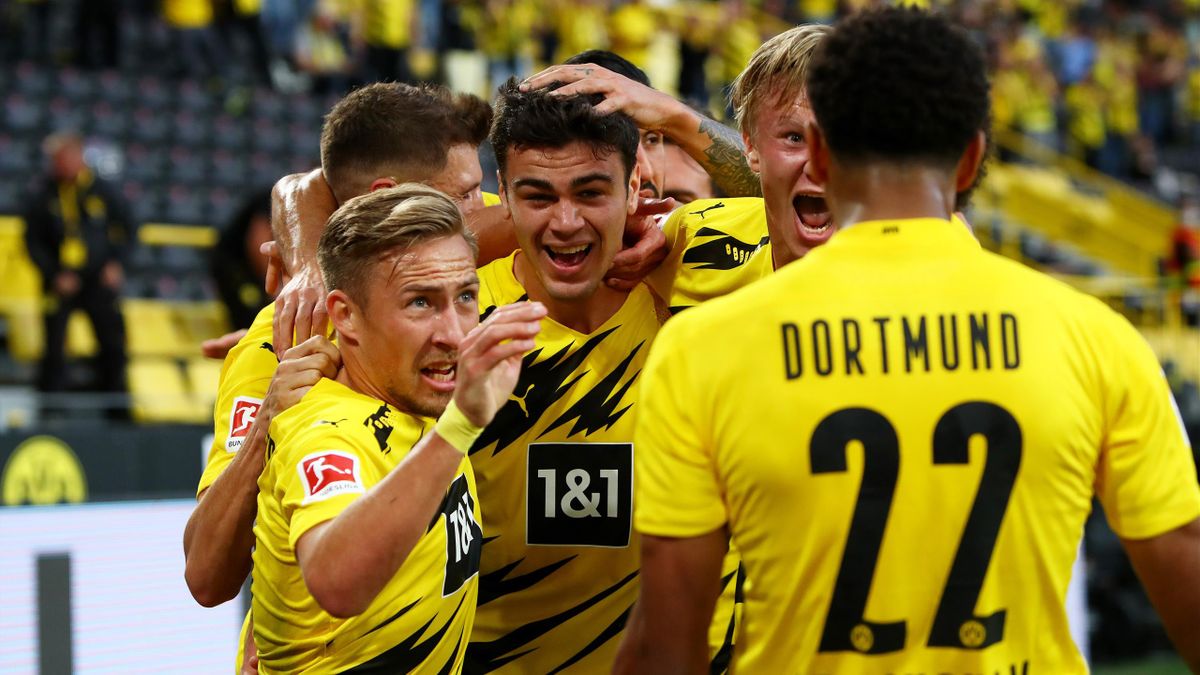
In the picture (credit goes to Getty Images): Under-23 players have scored all but one league goal Borussia Dortmund have produced so far this season while providing an assist for every single one of the seven.

My Research: Homegrown vs Foreign

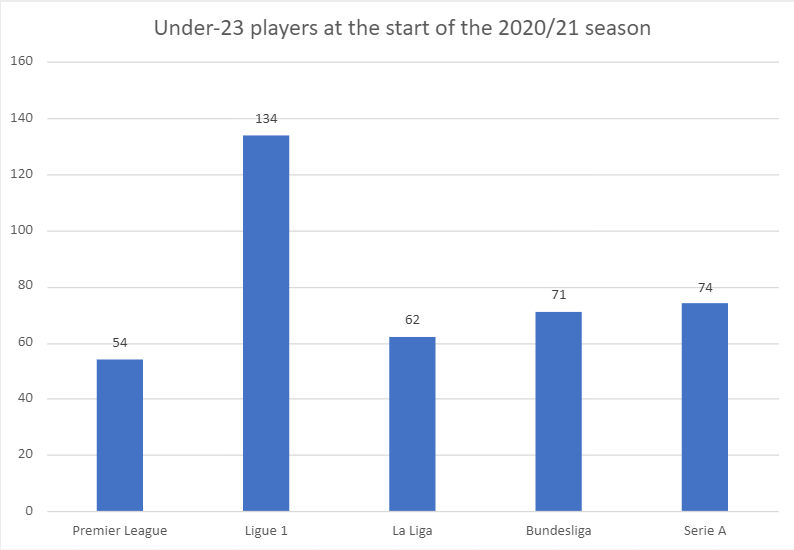
A total of as many as 395 under-23 players – born in 1998 or later – have made at least one appearance in one of Europe’s top five leagues at the start of the new season.

Perhaps unsurprisingly, the French Ligue 1 is responsible for nearly 34% of the number, ahead of the Italian Serie A (18.7%), the German Bundesliga (18%), the Spanish La Liga (15.7%) and the English Premier League (13.7%).

I have also researched not only where all those under-23s come from, but more specifically – where they received their footballing education, i.e. whether they can be classified as homegrown players.

However, I have taken into consideration where they were schooled during the foundation phase of their development.

(This means that if you left your home country at the age of nine – as, for example, Nantes and France U21 goalkeeper Alban Lafont reportedly did when moving from Burkina Faso to France at that particular age – or later, you were still classified as a foreign youth product.)

Ligue 1 boasts the highest percentage of homegrown under-23s, just ahead of the Premier League and La Liga.

In the Bundesliga and in the Serie A most under-23 players are currently foreign.

Visit this blog next week for ‘Young Teams to Watch in 2020/21’.

In the picture (credit goes to Africatopsports): Alban Lafont was born in the Burkinabe capital of Ouagadougou before moving to France at the age of nine

Foundation Phase: Paweł Guziejko

If we see chaos on the pitch, it means everything is OK.

Have you ever seen a child dribbling with the ball past four or five players before eventually losing possession?

Probably a lot of times.

But have you ever thought about the benefits of the situation?

“He dribbles with the ball, always against an opponent, he makes decisions, he learns how to play football”, points out Paweł Guziejko, founder of the Pav Funball coaching programme for children.

“If the child regularly takes players on, it’s OK. If he is good at it, but remains unable to use the skill at the right time, this is what we [as coaches] are there for, to help him.

Do not tell him not to dribble, but [instead] try and give him a challenge, for example: ‘listen, think about when to dribble and when to pass’ [the ball].”

Guziejko, who has worked as a coach in Poland, United States and England, is a big believer in the psychological and social development of children, rather than players.

He discusses various aspects of foundation phase football with Breakthrough.

KEY OUTTAKES

1. “Ninety-five percent of the human brain is developed by the age of five.”

2. “We are only able to remember two or three pieces of information.”

3. “The two most important features are creativity and curiosity.”

4. “The brain needs a dose of positive emotions during training.”

SIMPLICITY

“A child only needs a ball and two goals.”

‘SUPER INTELLIGENT’ CHILDREN

“We have nothing to say. Leave them alone and do not disturb them at all.”

SMALL-SIDED GAMES VS BIG PITCH

Question: do we, as coaches, progress to games involving more players too early?

“To begin with, everything has been drawn up by adults. We don’t ask children. We believe they have no right to speak and are generally quite ‘silly’. What’s the point of asking children what their needs are and what they want to do on the pitch?

“Everything that was created for children such as school, football and other sports, every programme has been designed by adults, without taking into consideration whether children are interested in it.

“Above all, there are two questions to be asked. First, how do children learn? This is the basic thing. And second, are they ready to progress to the next stage?

“Overall, children need to play in small spaces and in big spaces. If you look at senior and 11-a-side football, there are small-sided games [within the ‘big’ game] and sometimes there is a lot of space. It has to balanced.

“But if we stubbornly do everything ourselves and do not let children speak, their whole process of learning will be very much slowed down.

“For example, let’s say there is a five-a-side, under-8s game and we throw children at the deep end. Let’s look at how the goalkeeper or indeed any other player behaves. They have so many options to choose from. If you have four of them, it’s already an awful lot. And if you have six of them in a seven-a-side, it’s a complete disaster for the child’s brain. There is so much information from everywhere. Only ‘super intelligent’ children will be able to quickly adapt. But there’s so few of them.

“If you play 3v3 or 2v2 [games] for a long time, the child only has one or two options to choose from and they learn, for example, when to pass and when to dribble. In a simple, 2v1 game that will then also occur on the big pitch, the child’s brain will remember the good choice. Then you repeat the situation for a specific amount of time and you later move from 2v1 to 3v3 games and so on.

“But the learning process does not last one or two weeks because we learn all our lives really. It’s a process. The child will then play a 5v5 game and will find themselves in the same situation on the pitch, 2v1, but because they already solved the same problem in the past, having only one teammate and one opponent, it will be a lot easier for them to now solve it in a 5v5 or 7v7 game.

“The decision will be made quicker and easier. The brain remembers the choice and the child remembers how to behave in a given situation. They will be a lot more effective in solving the problem and making not always good, but better decisions.”

THE CHILD

Questions: where lies the balance between what the child wants and what good for them is?

“There has to be a balance, but if you understand the child and you know how the child learns… What do you know about the child outside of football? Do you talk to the parents? Have you asked them how the child learns? Only then you will be able to find the balance.

“If the child likes something, I believe it is good for them.

“The main problem is that coaches compete for qualifications, tactically and in copying and pasting training sessions from the internet into their notebooks.

“But the little human being in front of them comes to training for one main reason: he wants to be with his peers, first and, second, play football. And because little kids are not brave enough to tell the coach that they don’t enjoy something…

If the coach is approachable, it’s a lot easier.

“The balance also lies in chaos which we, as adults who have a ‘shaped’ way of thinking and a ‘shaped’ way of what senior football should look like, don’t like.

“As for children, there will always be chaos because brain develops until the age of 25. Their brain is completely different and learns in a different way, they never think logically.

“If we see chaos, it’s the best for child’s development. But we immediately intervene. Let’s say there is a 5v5 game. Eight-year-olds play, there is chaos and suddenly the match is stopped. ‘No, you have to position yourself there, you need to be there’. And the child looks at you as if you were silly and thinks: ‘what does he want from me? I’ve come here to play and have fun!’

“This is our adult intervention into not understanding the child, how they learn, how motor habits are formed, how neurons appear and so on…

“The latest research around the world shows that chaos is best for child’s development and learning. Children will always play football chaotically.”

COACH’S EGO

“The problem is that people working with children seem to think that because of the fact they obtained qualifications and can call themselves ‘coaches’, they know everything and are there to teach football to the little kids who themselves are there to listen to the coaches.

“As long as such relationship is maintained, some individuals will still progress, but football will be permanently losing a lot of children.”

INDIVIDUAL DEVELOPMENT

“A lot of teenagers have shortcomings in their individual game understanding, in the technical-tactical competences such as self space management, timing, positioning, changing direction – when and how to do it – receiving the ball, what to do when you’re marked and when you’re unmarked and so on.

“If you don’t possess individual skills at a required level, it will be very diffcult for you to learn group and team tactics.”

Paweł has also worked as a Football Association skills coach at the foundation phase level and at professional club academies as foundation phase and youth development phase coach. He is a book writer, too. You can follow him on Twitter

Design a site like this with WordPress.com
Get started