How It All Began: Mason Mount

He just wanted to get on with it.

“One time at school”, Mason Mount pauses although the memory seems still fresh. “A policeman came in to speak to us about a career after school.

“He came to me and I said: ‘I want to be a footballer’. He just laughed at me and said: ‘yeah, everyone wants to be a footballer’.”

The police officer clearly had no idea who he was talking to. And you cannot blame him. Mason Mount has had a desire very few can even think about matching. In any walk of life.

A fighting spirit his granddad has taken credit for.

“He’s a massive part of my life”, the grandson has himself admitted. “He always used to come to my training. He was a tough boxer and I was learning from him when I was younger.

“He was telling me to never give up and keep working hard.”

It was not all about the granddad – grandson relationship though.

“Mason’s passion for football was already in him”, believes Mason’s father, Tony. “It was just there. He was always kicking a ball all around the house, driving you mad.

“He would use his [older] sister as a target”, recalls Debbie Mount, Mason’s mum. “‘If I hit your head, that’s my bull’s eye!'”

“I knew nothing but football”, sums up Mason himself.

“He just wanted to get on with it and train”, Kevin Neal, Mount’s first coach, remembers. “He didn’t want to do what other little kids at the age of six did, messing about. He just wanted to train.”

There was a lot of enthusiasm, too.

“I try to base my free-kick on [Cristiano] Ronaldo, hit the ball by the valve so that it moves”, young Mason once said right in front of a camera. “That’s all I do. Top corner, top bins!”

He then did exactly what he had just said.

The passion soon resulted in progress. One that demanded a huge sacrifice. From Mason as well as from his parents.

“A scout approached us about Mason going up to the [Chelsea] development centre at Cobham”, Tony Mason revealed. “He was still playing Sunday football with Boarhunt and then Chelsea offered him a place in the academy.

“Then it became: Tuesday night training, Thursday night training, Saturday morning training and Sunday fixture.

“That would be regular from the age of eight up through to 14.

“It became grinding at times, for us as well as for Mason, but you just did it. He never missed many training sessions. I could probably count them on one hand!

“At times we used to encourage him: ‘have a night off training, do something different, go to the party, have a sleepover’. He would say: ‘no, I want to go training’.”

Mason acted like a professional even before he became one.

I was always so focused. I wanted to go home, have a good night’s sleep, ready for the next day, going to school and then training after.”

“It just seems like yesterday he was six years of age, bouncing and waiting to get in the car and drive up to the academy. He’s achieved what he always dreamt of and what he’s always believed in.”

Football Families: The James’

It’s been a team effort.

If you think what may be regarded as an old-school approach has gone entirely out of fashion, you may have to think again.

What is more, it can still prove highly effective.

And at the very least, it has in the case of one particular family.

“It was just about playing”, recalled Nigel James who in the past would use somewhat ethically questionable techniques in order to motivate his three children.

“I used to set them challenges in the back garden and if they did well at that, I’d give them 20p and then another 20p”, he remembered.

“Before you know, you’ve changed up £20 into 20ps and they’re all gone! It became fun.

“The key thing was that they were doing the right things. If you don’t know the standard that you have to set yourself then there is no way they will improve. In the end they pushed themselves to get better.”

Nigel James is not one of those parents who some may describe as crazy or out of touch.

Quite the opposite, in fact.

The father of Joshua, Reece and Lauren – the latter two of which have recently become the first-ever brother and sister to be called-up to England senior national football teams – is a highly-regarded football coach who has reportedly played his part in the development of an impressive total of over 20 professional footballers.

Once a promising, but eventually an unfulfilled player himself, he makes no secret of his approach to coaching youngsters.

It’s all about discipline“, the founder of the Nigel James Elite Coaching (NJEC) academy admitted.

“Having the right kit, making sure your boots are clean, and acting professional at all times. These things are vitally important. I wouldn’t expect anything less.

“You’ve got to show that authority. If you’re straight with them, you can expect them to be straight with you.”

There is more to Nigel James the coach, though.

Much rather than letting out his own frustrations, he wants to provide young players with what was not afforded to him back in the day.

“After the injury [James senior suffered in a motorbike accident while on the books of Aldershot] I lost confidence in myself”, he told TalkSport.

“If you’re not surrounded by positive people in those situations who help pick you up, then it plays on your mind even more.

“When I was at Aldershot I didn’t feel as though I had that support network. I fell out of love with the game.

“I was in a very lonely place back then. I was living in London and getting the train to Aldershot and then getting back home late at night. I wasn’t enjoying it.

“To make matters worse you get told a pack of lies. The usual stuff like ‘keep your head up and try to be positive’. 

“The bottom line is I was sold a dream. People sell people a dream just to keep the numbers up. That’s the reality of it.”

James stopped his playing career at the tender age of 19 and moved into coaching. His under-8 team soon included the likes of Conor Gallagher (now on loan at West Bromwich Albion from Chelsea), Ian Poveda (Leeds United) and Alfie Doughty (Charlton Athletic) as well as his own children.

His approach may be seen as old school indeed.

But with a reason.

“Having that mutual respect goes a long way,” he believes. “Here at NJEC we have that with all of our players and parents. We’re a big family.”

There was no messing about in his own family’s back garden either.

Frequent coaching sessions may have helped in Joshua – who was on the books of Fulham and Reading at youth level – Reece and Lauren all falling in love with game.

“Lauren had to learn quickly,” he told The Guardian. “Otherwise she didn’t get the ball.

“When she and her brothers were having a kickaround, they wouldn’t let her just come and take the ball. She had to work very hard to get it. And when she did get it, they made sure she didn’t have it for very long!”

The type of father he was Nigel would never step in.

Success requires determination, he knew all too well.

Maybe it is not then all old school after all.

Foundation Phase: Birmingham City

Earlier this week I took part in a webinar with Birmingham City Academy Head of Football Stuart English as guest. Here are some of the takeaways.

  • The Birmingham City Academy divide coaching from the under-7 up to under-11 age groups into three phases: possession, attacking and defending.
  • Possession is split into: (1) individual, (2) group play, (3) directional.
  • Attacking is split into: (1) individual, (2) group play, (3) with and against overloads.
  • Defending is split into: (1) individual pressure, (2) small group pressure, (3) regain and play.
  • At the foundation phase level, the BCFC Academy focuses on principles rather than position, individuals rather than team and intent rather than execution.
  • They have also decided to shift away from a rigid, conformed and regimented environment to a more artistic one, valuing flair and individuality.

As for their best-known, recent gradute:

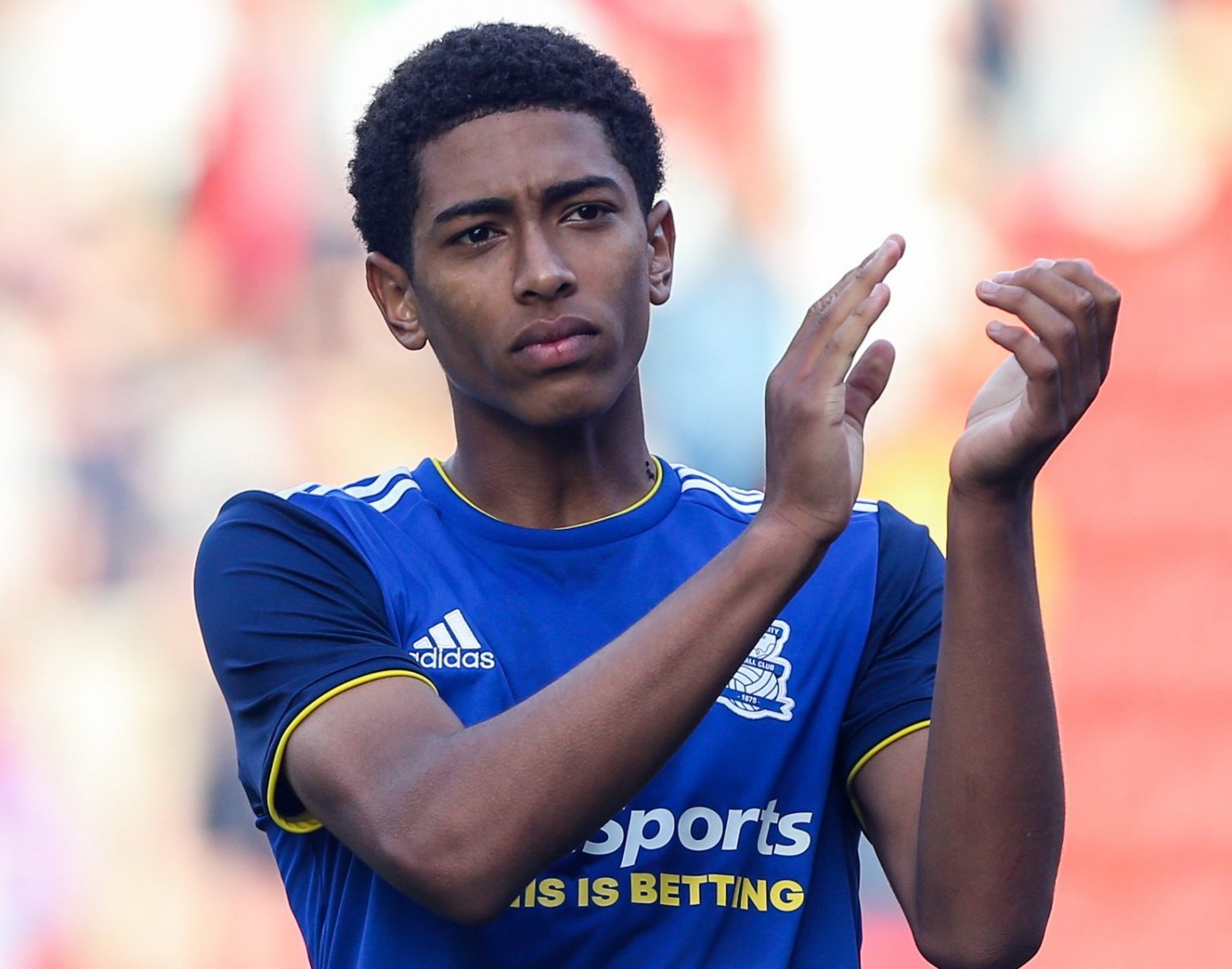
  • Jude Bellingham has always had a huge passion for football.
  • He has been very agile.
  • He used to be physically small, having only drastically grown up aged 14 to 15.
  • He tended to play both with his peers and above his age group, even two or three years up.
  • He would often get irritated that players of his age were not able to play at the level he demanded.

In the picture (found here): Jude Bellingham joined the Birmingham City Academy at the age of seven

My Research: Relative Age Effect

I have looked into months of birth of all under-23 players who have appeared in Europe’s top five leagues and the group stages of Champions, Europa and Nations Leagues so far this season.

CONCLUSIONS:

  • Under-23 players born in the first quarter of a year dominate in every single competition analysed, with players born in the second quarter of a year always directly behind or, in only one instance, level.
  • Under-23s born in the last quarter of a year come bottom in most competitions analysed.

NOTE:

For players having come through the English system I treated September as the first month of a year, October as the second and so on.

PREMIER LEAGUE:

Out of 66 under-23 players to have made at least one Premier League appearance so far this season:

  • 24 (36.4%) were born in the first quarter of a year,
  • 22 (33.3%) were born in the second quarter of a year,
  • 12 (18.2%) were born in the third quarter of a year,
  • 8 (12.1%) were born in the fourth quarter of a year.

Among under-23s who have come through the English system not a single one was born in August, i.e. the last month of the year. Southampton’s Michael Obafemi and Nathan Tella are the only two to have been born in July, i.e. the penultimate month of the year. Leicester’s Luke Thomas, Everton’s Tom Davies and Crystal Palace’s Eberechi Eze are the only three to have been born in June.

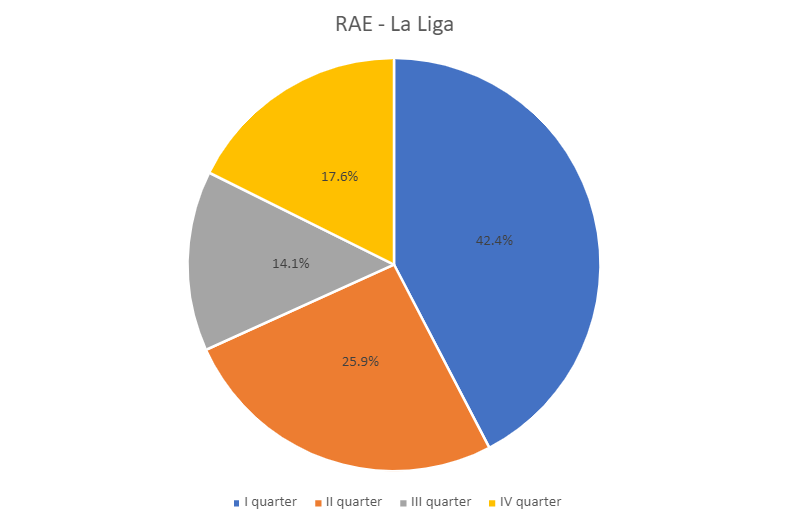
LA LIGA:

Out of 85 under-23 players to have made at least one La Liga appearance so far this season:

  • 36 (42.4%) were born in the first quarter of a year,
  • 22 (25.9%) were born in the second quarter of a year,
  • 12 (14.1%) were born in the third quarter of a year,
  • 15 (17.6%) were born in the fourth quarter of a year.

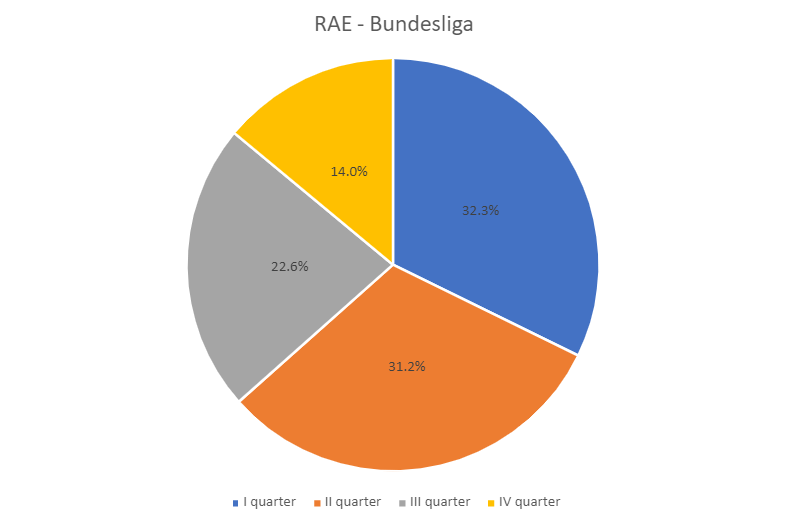
BUNDESLIGA:

Out of 93 under-23 players to have made at least one Bundesliga appearance so far this season:

  • 30 (32.3%) were born in the first quarter of a year,
  • 29 (31.2%) were born in the second quarter of a year,
  • 21 (22.6%) were born in the third quarter of a year,
  • 13 (14%) were born in the fourth quarter of a year.

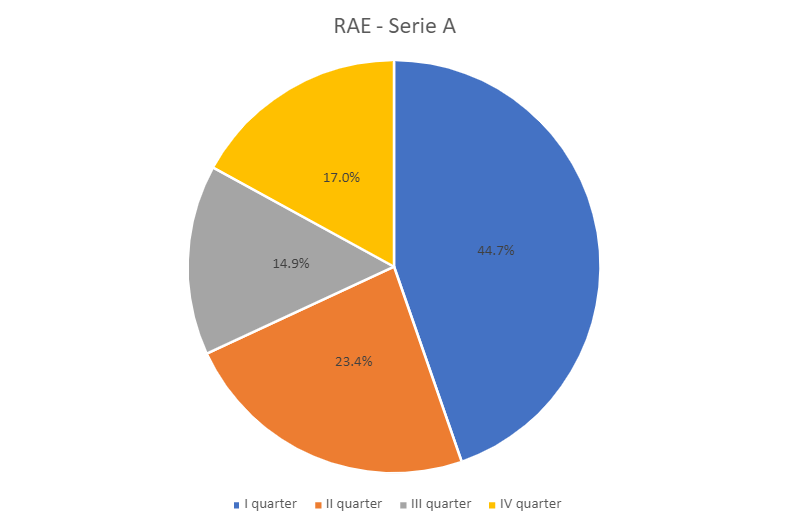
SERIE A:

Out of 94 under-23 players to have made at least one Serie A appearance so far this season:

  • 42 (44.7%) were born in the first quarter of a year,
  • 22 (23.4%) were born in the second quarter of a year,
  • 14 (14.9%) were born in the third quarter of a year,
  • 16 (17%) were born in the fourth quarter of a year.

LIGUE 1:

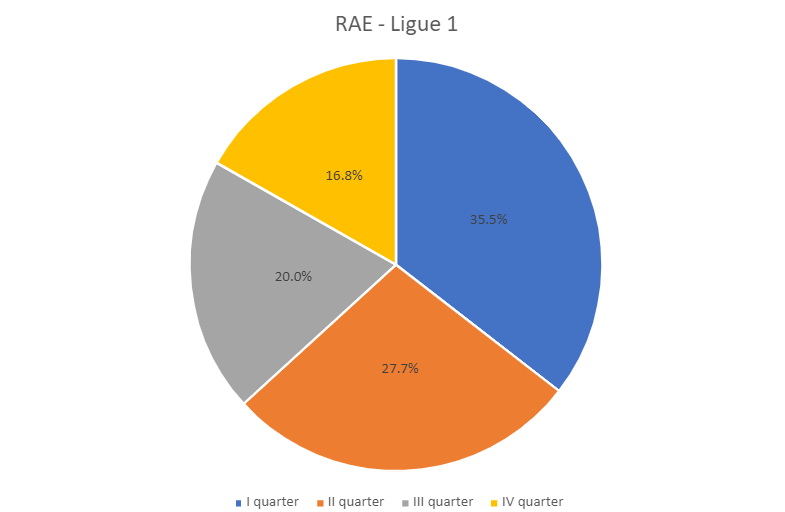
Out of 155 under-23 players to have made at least one Ligue 1 appearance so far this season:

  • 55 (35.5%) were born in the first quarter of a year,
  • 43 (27.7%) were born in the second quarter of a year,
  • 31 (20%) were born in the third quarter of a year,
  • 26 (16.8%) were born in the fourth quarter of a year.

TOP FIVE LEAGUES:

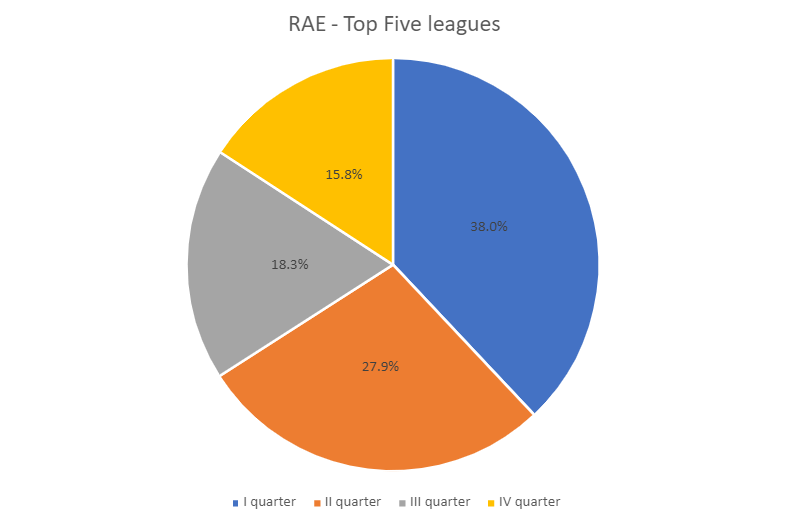
Out of 487 under-23 players to have made at least one appearance in one of Europe’s top five leagues so far this season:

  • 185 (38%) were born in the first quarter of a year,
  • 136 (27.9%) were born in the second quarter of a year,
  • 89 (18.3%) were born in the third quarter of a year,
  • 77 (15.8%) were born in the fourth quarter of a year.

CHAMPIONS LEAGUE:

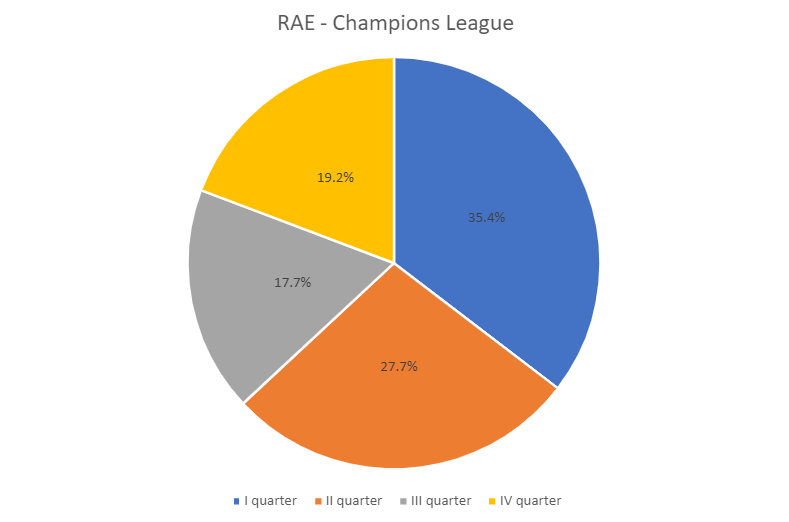
Out of 130 under-23 players to have made at least one Champions League appearance so far this season:

  • 46 (35.4%) were born in the first quarter of a year,
  • 36 (27.7%) were born in the second quarter of a year,
  • 23 (17.7%) were born in the third quarter of a year,
  • 25 (19.2%) were born in the fourth quarter of a year.

EUROPA LEAGUE:

Out of 232 under-23 players to have made at least one Europa League appearance so far this season:

  • 75 (32.3%) were born in the first quarter of a year,
  • 67 (28.9%) were born in the second quarter of a year,
  • 50 (21.6%) were born in the third quarter of a year,
  • 40 (17.2%) were born in the fourth quarter of a year.

NATIONS LEAGUE:

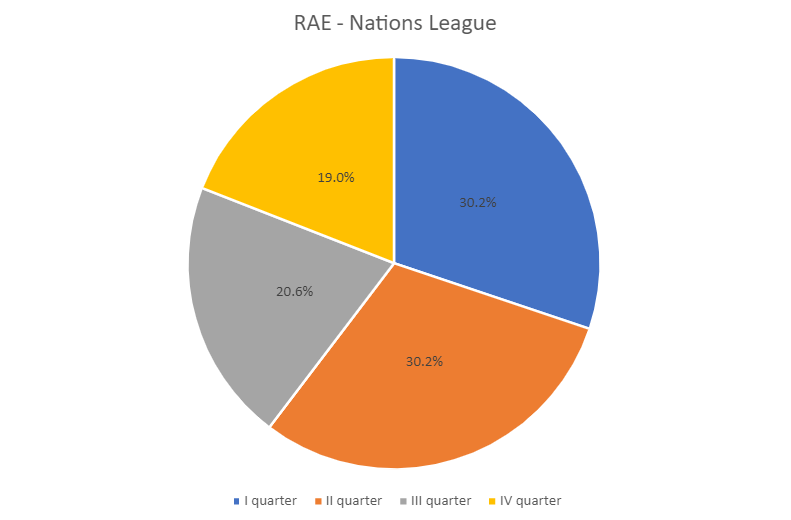
Out of 63 under-23 players to have made at least one Nations League appearance for one of 24 Euro 2020 participants so far this season:

  • 19 (30.2%) were born in the first quarter of a year,
  • 19 (30.2%) were born in the second quarter of a year,
  • 13 (20.6%) were born in the third quarter of a year,
  • 12 (19%) were born in the fourth quarter of a year.

All data is up to date as of 13 November 2020.

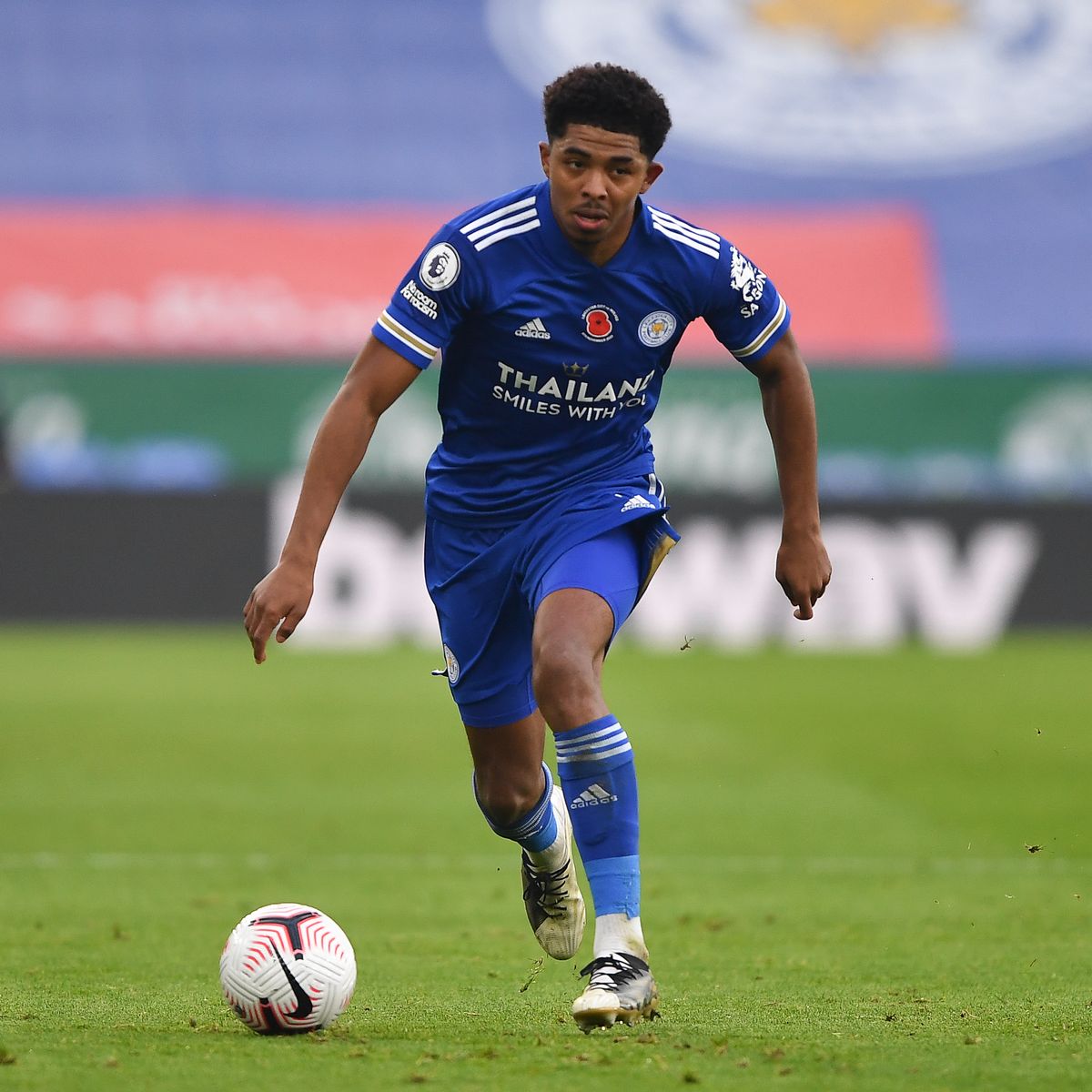
In the picture: Leicester City’s Wesley Fofana is currently one of just two Premier League under-23 players who have been born in the last month of a year (credit: Getty Images)

Design a site like this with WordPress.com
Get started